Monthly Archives: February 2016

How winter’s bone tests us

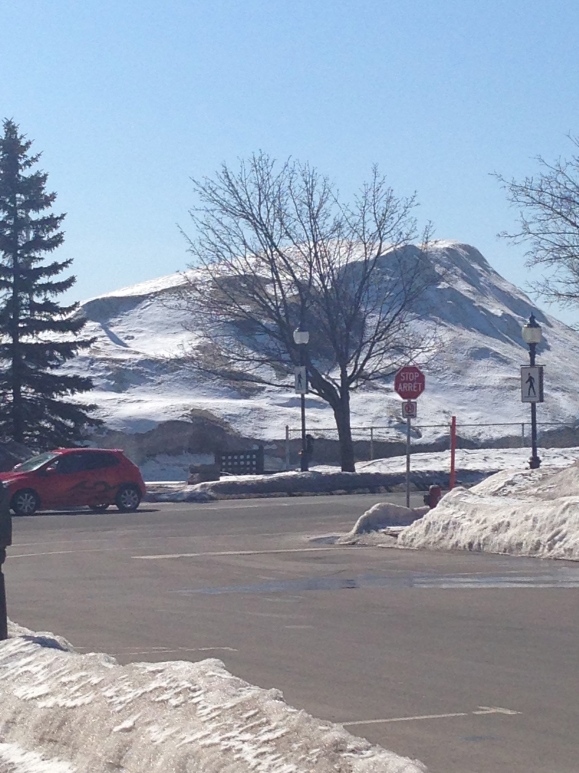
Permanent winter for a Moncton events centre?

We may remember the dreaded winter of 1992. Perhaps we choose to forget in the Hub City, which took the brunt of one of the worst white dumps in the recorded history of the province.

My sister was living here at that time and she remembers – so well, in fact, that she rarely sets foot in this fair town after the fall equinox and before the summer solstice.

The snow in 1992 reached the second-floor window of her apartment near Steadman Street. To escape, to get, say, milk and eggs, she crafted a makeshift bunny hill on which she slid to ground. (How she returned to her abode, I’m not entirely clear; something about climbers’ axes and pitons hovers into my long-fossilized mind).

The point is, as rough as we’ve had it recently in New Brunswick. . .well. . .it’s been rougher.

Nineteen-Ninety-Two was also the first full year of a brand, new tax introduced in a brand, new recession – the HST. As the snow continued to fall, joblessness in this province rose well above 15 per cent. Poverty and illiteracy rates were among the highest in the country. Violent crime was a daily occurrence in Moncton’s downtown core, which was, by the way, easily mistaken for certain boroughs of the burning, benighted southern reaches of London, England, where hooligans and punks roamed the streets nightly.

Last winter, one snowplow driver told Global News, “We’ve got as much snow now as we had then (in 1992). But then it came kinda all in like two or three days where this has taken a week. Then, we could not even drive with the truck with the wing down.”

All of which is to reiterate that notwithstanding last winter’s absurd “White Juan”, which seemed to last for weeks (trust me, it did; I have the pictures to prove it to my Los Angeles-based, Venice-Beach hovering, muscle-bound brother), we’ve actually had it pretty good in Moncton over the past two decades.

We’ve rebuilt our local and surrounding economies. We’ve diversified away from solitary, single industries and into integrated, diverse ones. We’ve embraced the notion of cultural and linguistic duality so completely that we’ve managed to host a baker’s dozen of major, international francophone events without materially or socially threatening anyone in this community who can’t (or doesn’t) speak and read the French language.

We have become, in effect, what we intended to become: a cosmopolitan city that welcomes newcomers with a shake of the hand and a slap on the back; an urban centre of 140,000 people that, on a good day, habitually behaves as if its region is ten times larger, as if its heart is 20 times as big, as its census data routinely reports.

We may one day remember the dreaded winters of 1992, 2015 or, indeed, the one we’re in.

In the meantime, the HST will surely rise. Toll fees will surely smack travellers on provincial highways. Income taxes might rise.

But all of this won’t stop us from inventing better tools for digging out from under an avalanche of debt and deficit. We are, in the end, remorselessly resourceful; we will outlast this particular winter.

And if we do eventually touch that rim at the edge of the world – on a hot summer day when the clouds gather over the ocean, and the sun shines through and onto New Brunswick – it will be ours to grab.

We will have sacrificed the memories of bad times to erect those of good ones, when winter’s bone does not so easily test us.

Tagged

The palaver over pipelines

DSC_0240

In fact, he does looks like the kind of fellow who could tell the nation’s provinces, leading mayors and other assorted high-profile camera moths to, in effect, knock it off – and even get away with it.

On his worst day, New Brunswick MP and Government House Leader Dominic LeBlanc presents and comports himself like Hollywood’s latest incarnation of an emerging mafia Don – though, an uncharacteristically friendly version of the cinematic phenotype.

Not that there’s anything wrong with that. I quite like his latest declaration to the press about the most recent, and utterly mindless, fracas over pipelines in this increasingly God-forsaken land of ours.

In the aftermath of some 80 mayors from Quebec, and that province’s premier, declaring their opposition to the proposed Energy East pipeline traversing their respective territories en route to tidewater facilities in Saint John, Mr. LeBlanc had this to say to local newspaper reporters this week:

“We’re prepared to deal with the tough issues and recognize that the (federal) government has an important responsibility to help get natural resources to market. The whole country has benefitted from the Alberta resource economy, so I think it would be helpful that everybody lower the tone, allow the regulatory and review process to run its course and then the government will have to make a difficult decision.”

He’s not kidding.

Gosh, what shall we do with all that Alberta oil and gas? Truck it just so that poor roads and driver inattention may slam it into a government-built tourism kiosk somewhere outside of Thunder Bay? Rail it just so that poor tracks and conductor inattention conspire to blow up another small town in the middle of Great White North Country?

Or shall we finally recognize that as long as we need fossil fuels to power our domestic and export economies, the safest, cleanest delivery system is still the lowly pipeline – properly built, scrupulously regulated and strenuously monitored by officials of the Departments of Natural Resources and those of Environment Canada?

Still, even the logical choice is fraught with political peril. And Mr. LeBlanc knows this perhaps better than anyone outside the Prime Minister’s Office.

Any delay in the construction and activation of eastern and western pipelines automatically aggravates the Conservative west, whose political agents in Ottawa are prepared to make hay with their talking points about the hegemony of the Liberal east.

Conversely, anything other than rigorous, proof-providing research showing that pipelines are, indeed, the safest technologies currently available for transporting evidently toxic materials over long distances is sure to inflame the environmental lobby and their confederates at the municipal level of government.

Tough issues, indeed, with which the federal government seems determined to deal. Ultimately, Mr. LeBlanc says, it’s Ottawa’s choice to make. And that choice, he insists, “will be based on the information that comes from the robust independent review (underway). It won’t be based on someone’s news conference. I’ve always thought that the government decision should be based on evidence, on science, on environmental analysis, on expert opinion.”

Of course, I take one issue with this declaration: It already is.

According to a recent piece in the Financial Times, “Moving oil and gas by pipeline was 4.5 times safer than moving the same volume the same distance by rail in the decade ended in 2013 in Canada, according to a new study by the Fraser Institute public policy think-tank.”

By all means, Mr. LeBlanc, complete your analysis, ensure that it is correct and then let’s get this oil flowing in the safest, most economically expedient means possible.

Tagged

For whom the road tolls

DSC_0238

“Popular” is not exactly the word that leaps to mind when talking about toll roads and tax hikes, but if you’re contemplating steps to render both as facts of life for New Brunswickers, a little spin goes a long way.

So it was earlier this week when the provincial minister of the Gallant government’s strategic review, Victor Boudreau, and Finance Minister Roger Melanson, very nearly spilled the beans, observing that of all the options for eliminating the provincial deficit they’ve presented to the public, the most “popular” were tolling roads and raising the HST.

Of course, neither Liberal MLA spoke directly to either issue in advance of next week’s budget, preferring, instead, to issue vague assessments of the vox populi’s current mood on the twin subjects of spending cuts and revenue raising.

Mr. Boudreau: “There has been a lot of work being done over the last number of months. I do think you’re going to see something that is going to, at the end of the day, address the fiscal challenge we are facing as a province, but doing it while maintaining. . .balance.. . .New Brunswickers have made it clear they don’t want to see deep cuts to health care and education.”

He also allowed that the debate over toll roads has been the most interesting component of the consultations: “A lot of people want tolls, but very few people want to pay for them.”

There you have it, ladies and gentlemen: This province’s existential problem in a nutshell. We New Brunswickers want to lasso the moon; we just don’t want to buy the rope.

In this, of course, we’re no different than anyone else. Still, our unique set of economic circumstances insists that we adopt a colder-eyed approach to solving our shared problems than ever before.

When Mr. Gallant began his review of government spending months ago, he declared that everything was on the table – on both the expenditure and revenue side of the ledger.

If that’s true, then next week’s budget should reveal a dramatically reduced (in both size and cost) civil service, with those savings redirected into strategies and programs that are likely to grow the economy and create jobs and, in so doing, goose tax revenues to public coffers.

But let’s not kid ourselves. We are well past the point where even the most efficiently run government and bureaucracy can pull our fat from the fire. This is not an overnight proposition. It will take years of lean, mean management in the public sector to keep the ship of state of a steady keel.

In the meantime, emergency measures are urgently, if lamentably, necessary. And that means tolls and taxes, neither of which, incidentally, need be especially onerous.

Virtually every economist I’ve consulted over the years stipulates that taxes on consumption are eminently more efficient and fundamentally fairer than levies on income. What’s more, those who subsist below a certain standard of living ought to receive rebates equal to their HST outlays.

Indeed, if all provinces along the East Coast actually harmonized again their harmonized sales taxes into one 15 per cent regime for all, as Nova Scotia Premier Stephen McNeil suggests they do, the unfair competitive pressures on the private sector would melt.

Tolls are somewhat more difficult to administer and collect than taxes without undermining the monetary value of the exercise, itself. But it can be done, and to great effect, as it is in other jurisdictions across North America.

Think of taxes and roadway fees as temporary measures that, nonetheless, toll for thee.

Tagged , , , ,