Author Archives: brucescribe

Should New Brunswick become Legoland?

img-20120908-00211

My grandsons are hopelessly, faithfully, determinedly in love with a little Danish block that appeared almost a century ago in the workshop of Ole Kirk Khristiansen.

As the story goes, faithfully recounted by Wikipedia (surely, by now, we may trust the source), “in 1916, Khristiansen purchased a woodworking shop in Billund which had been in business since 1895. The shop mostly helped construct houses and furniture, and had a small staff of apprentices.”

Naturally, of course, “the workshop burned down in 1924 when a fire ignited some wood shavings” – the kind of misadventure that literally prescribed the fortunes of post-industrial, small-time manufacturing operations the world over at that time.

But good old Ole Kirk was made of stern stuff. First, he built “a larger workshop, and worked towards expanding his business.” Then, when the ‘Dirty Thirties’ settled in, he decided to “focus on smaller projects (and) began producing miniature versions of his products as design aids. It was these miniature models of stepladders and ironing boards that inspired him to begin producing toys.”

And, so, Lego was born.

These days, thanks to my grandsons and millions of other grandsons and granddaughters (and parents and uncles and aunts and, yes, grandparents), the brand is riding high on a global marketing tidal wave.

This is from reporter Katie Hope, writing for cityam.com the other day:

“Lego yesterday laid out its plans to dominate the world toy market after revealing sales for last year that trumped the general market. The Danish maker of colourful toy bricks, already the world’s second largest toymaker after barbie-maker Mattel, said it expected to continue to grab market share. The popularity of its city range, which features police and firemen as well as its China toy tribe of animal warriors, helped to drive sales up 11 per cent in 2013, outperforming the global toy market which fell slightly in value.

“Net profit at the firm rose nine per cent to 6.1bn (£673m) kroner from 5.6bn in 2012. . .Revenues rose 10 per cent to 25.4bn kroner. . .It said it now employed 180 designers across 24 different countries as the group’s ‘creative core’, charged with creating new products. Lego’s popularity means that on average each person on Earth owns around 86 of its bricks.”

Actually, I own about 450 pieces from the 1960s. I won’t hazard a formal inventory of my nephew’s horde, but I imagine his collection now tops 10,000. My legacy boys, Euan and James, are beneficiaries of the extended family’s generosity.

But I wonder whether there’s a broader benefit to be extracted from all of this – an example that Denmark sets for debt and deficit-laden New Brunswick. Indeed, is there one for all of Atlantic Canada?

To what depth of ingenuity – apart from the technology required to exploit our natural resources – have we in this region of Canada plumbed to invigorate our entrepreneurial class of decidedly home-grown producers and job-generators?

It’s true, we have the great family firms who employ thousands of people. In the Maritimes, alone, the names Irving, McCain, Sobeys, Bragg and Jodrey lay testament to   a vigorous form of private enterprise that stands the test of time.

Still, what of the future? Where are the new brands consecrated by, even reconstituted from, the old ones?

Lego has effectively reinvented itself at its birthplace in northern Europe. It continues to provide jobs there as it expands, like a juggernaut, everywhere else. Its secret is simple, or so it says for itself on its website:

“Curiosity asks, ‘Why?’ and imagines explanations or possibilities. . .Playfulness asks ‘What if?’ and imagines how the ordinary becomes extraordinary, fantasy or fiction. Dreaming it is a first step towards doing it. Free play is how children develop their imagination – the foundation for creativity. . .Creativity is the ability to come up with ideas and things that are new, surprising and valuable.”

Dreaming it is a first step towards doing it? Creativity is the ability to come up with ideas and things that are new, surprising and valuable?

Yes, that’s what my grandsons will say as they build their plastic spires into the imaginary sky.

Shall we ask any less of ourselves in the world we call real?

Tagged , ,

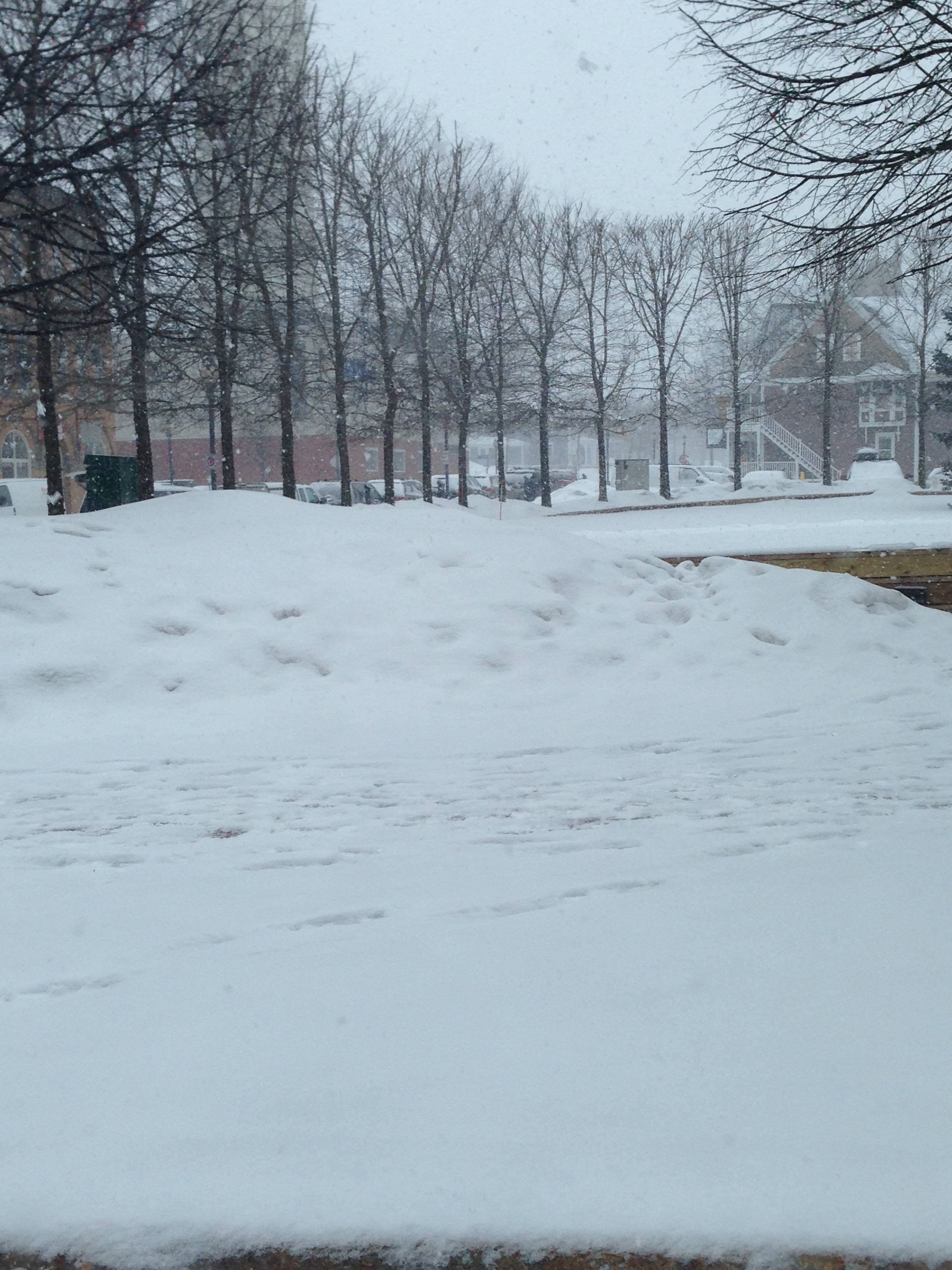
If it’s flooding or frozen, it must be March

DSC_0170

We don’t talk about it, not really, at any rate; for to talk about it would hex us forever.

Oh, sure, we chat discursively around the subject. We say things like, “Oh well, what are you going to do?” and “Geez, we weren’t expecting this” and “Maybe, it isn’t as bad as we think.”

No, it’s not the frightening situation in the Ukraine and the threat of reigniting the Cold War with Russia. It’s not the slightly less frightening situation in Ottawa and the threat of John Baird and/or Jason Kenney replacing the off-message (which means sensible and well-meaning) Jim Flaherty as finance minister just in time for Toronto Mayor Rob Ford’s next appearance on Jimmy Kimmel Live.

It’s none of these or other legitimate, though contrived, concerns that has us trembling in our mukluks. It is, however, a bug-a-bear that’s distinctly, uniquely Canadian at this time of the year. It’s (gasp!) the weather.

As to this – to quote a phrase in a book I once loved to read when the snow was as high as an elephant’s arse – what in the blue-blazes and billions of blue blistering boiled and barbecued barnacles is going on around here? (Apologies to Captain Archibald Haddock of “Tintin” fame).

There, now: I’m talking about it. Bad luck be-damned. It’s March 6, and it’s time for an earnest intervention with Planet Earth. I’ll start. Dear Gaia, are you kidding me?

I mean, I get that you’re peeved about all the junk we’ve been pouring into the atmosphere. But that’s supposed to warm things up a might. What’s with the walk-in freezer two weeks before the official start of spring?

Still, to a weather junkie, it’s all perfectly explicable.

“The latest public enemy No. 1 comes complete with an ominous, super-villain name and a tendency to waver drunkenly around the Northern Hemisphere, leaking great, vast gasps of frigid Arctic air into normally more temperate latitudes,” writes Larry O’Hanlon in Discovery magazine’s online edition. He is, of course, referring to the polar vortex which, he acknowledges has “always been there, but most of the time it minds its own business and serves as a wall of wind to hold wintry Arctic air where it belongs.”

Not this winter. This winter it has been, quite literally, all over the map. Hence the pronounced and prolonged cold. There’s even some suggestion that the active vortex is linked to – if not a direct result of – global warming.

“It may well be that global warming could be making the occasional bout of extreme cold weather in the U.S. (and Canada) even more likely,” Bryan Walsh writes in Time Magazine’s online edition. “Usually the fast winds in the vortex – which can top 100 mph (161 k/h) – keep that cold air locked up in the Arctic. But when the winds weaken, the vortex can begin to wobble like a drunk on his fourth martini, and the Arctic air can escape and spill southward, bringing Arctic weather with it.”

Essentially, warmer than normal air sinking from the stratosphere upsets the vortex’s flow and sends it madly off in all directions.

Good science is always a palliative for high anxiety, but history also provides a much-needed cold comfort. My trusty Canadian Weather Trivia Calendar 2014 proves that, for we citizens of the Great White North, March truly is, and always has been, the cruelest month.

March 5, 1900: “Snows whipped into monstrous drifts blocked trains near Brantford, ON. Two young passengers volunteered to get food at a nearby town. When they returned the hungry crowd began to devour everything in sight. After the meal, cigars were indulged and in and around 12 o’clock all retired to any spot providing comfort. Two men froze their ears walking 1 kilometer from one express train to another.”

Then, of course, only last year on March 20, the first day of spring, a storm “dumped 19 cm of snow on Moncton, NB, and nearly 40 cm of snow in Fredericton. The storm closed schools, caused power outage, and shut down offices.”

All of which confirms, if nothing else, that if it seems that the weather can’t get any weirder, it only seems that way.

The bottom line: There’s no use in complaining. Indeed, it’s best not to talk at all. With these temperatures, why waste energy?

Tagged ,

Fat and poor: What’s not to love about the East Coast?

Evidence of Atlantic Canadian exceptionalism mounts with each day that passes. Judging from the headlines, our position within Confederation has never been more secure, our role never more crucial.

Do we serve the rest of Canada as both the butt of their jokes and the source of their ire? Of course we do, and with brio, mister.

Merely consider the following from the Globe and Mail, Canada’s self-assured, self-identifying “national” newspaper, the other day:

“The number of obese Canadians has tripled since the mid-1980s, a phenomenon driven by a sharp rise in the number of extremely overweight adults whose health complications are expected to place a heavy burden on the health-care system.”

And where, pray tell, will we find the highest rate of corpulence in Canada?

“(The) burden is not spread evenly, with the highest proportion of obese adults in the Atlantic provinces and the lowest in wealthy and healthy British Columbia, according to a new study that predicts the country’s weight problem is only going to get worse, especially in the fattest provinces.”

What’s worse, the piece goes on to say, “the study warns that, if the trend continues, more than one in five Canadians will be obese by 2019. In five provinces – Newfoundland and Labrador, Nova Scotia, New Brunswick, Saskatchewan and Manitoba – there will be more adults who are overweight and obese than adults who tip the scales at a healthy weight that same year.”

Oddly, there’s no explanation for why Prince Edward Island, alone among East Coast provinces, is missing from the list. It’s conceivable that with a smaller population than Metro Moncton’s, the Island failed to impress itself as a province upon the study’s authors, one of whom is, herself, a resident of Atlantic Canada.

“We have a growing number of these people (overweight and obese) and we haven’t really sorted out the treatment. ” Laurie Twells, a prof in the faculty of medicine at Memorial University in St. John’s. “We’re not actually curing it (obesity). We haven’t managed to help people lose weight and keep it off, other than through something like bariatric surgery.”

Now, as other research links obesity with straightened socio-economic circumstances, it should come as no surprise to anyone that Atlantic Canada is not only home to the nation’s highest proportion of fat people; it’s also home to the highest proportion of poor ones.

According to Statistics Canada’s The Daily a year ago, “the income gap between the top one per cent and the rest of filers has widened over time. In 1982, the median income of the top one per cent of filers was $191,600. This was seven times higher than the median income of $28,000 for the other 99 per cent of filers. By 2010, the median income of the top one per cent of filers increased to $283,400, about 10 times higher than the median income of $28,400 for the rest. The income of top filers was increasingly dependent on their jobs, rather than on investments.”

Meanwhile, “in 2010, four provinces – Ontario, Alberta, Quebec and British Columbia – accounted for 92 per cent of the 254,700 people in the top 1 per cent.

Ontario had 110,300, followed by Alberta with 52,200, Quebec at 42,600 and British Columbia with 29,500. Between 1990 and 2010, Alberta’s share of the top 1 per cent of filers doubled from 10 per cent to 20 per cent, while Ontario’s proportion fell from 51 per cent to 43 per cent.”

The only reason why no Atlantic province gets a mention is that the incidence of conspicuous wealth in the region is so rare, it’s statistically insignificant.

On the other hand, reported the Globe last year, “new data shows the share of individual income that comes from government transfers is highest in the Atlantic provinces. Three of those provinces. . .receive slightly more transfers than the total taxes they pay. The main factors appear to be higher unemployment in Atlantic Canada – but also an older population.”

Uh, no kidding Sherlock.

To be sure, though, we along the seabound East Coast might yet salvage some dignity. A new Scotiabank poll finds that Atlantic Canadian small business owners are more inclined than their counterparts elsewhere in the country to work until they drop.

That, too, makes us special among our countrymen.

Still, who’s complaining? As long as it keeps our minds off the junk food.

Tagged , ,

Jolting Moncton’s priorities to life

IMG_0654

The fact that Moncton city council even maintains a list of priorities to pursue in its effort to better the community it serves speaks volumes about the worthy preoccupation with thoughtful civic planning around here. After all, few municipalities of comparable size spend much energy crafting “to-dos” and even less time fulfilling them. 

Still, there is something broadly disappointing about an ersatz action plan (the existence of which came to light in the Moncton Times & Transcript last week) whose number one standard operating procedure is to “continue to foster a culture of fiscal responsibility.” Really? As opposed to what?

Had the vow been to spend money like this was our last day on Earth – to go into cosmic hock building a fleeting, terrestrial version of Paradise because the only debt collector is the Grim Reaper, himself, and he’s got bigger fish to fry – well. . .at least that would have been interesting. Irresponsible, but interesting.

What, exactly, is intriguing about a promise to keep our fiscal noses from running? Who and what is that supposed to inspire?

When I check my personal Ten Commandments, affixed via post-it note to my bathroom mirror, before my daily, morning ablutions, I do not see inscribed there, “Thou shalt not rob Peter to pay Paul. . .not today, anyway.”

Nowhere do I encounter admonitions to cut back on $4-a-cup cappuccinos or to switch to a cheaper, less talented hair dresser because, after all, a penny saved is a penny earned and that’s exactly what’s written on my calling card.

No, what I see staring back at me from my looking glass are phrases like “Go Big or Go Home!” and “Shock and Awe is a Way of Life!” and “Be Amazing!”

Okay, so maybe they’re not affixed to my bathroom mirror (who does that anyway?). But, over the years and with the help of boardofwisdom.com’s inspirational quotes page, I have made a small collection of various motivational squibs, none of which, I hasten to point out, has anything to do with maintaining a healthy bank account.

Here’s one: “Never tell me the sky’s the limit when there are footprints on the moon.” Here’s another: “I do it because I can, I can because I want to, I want to because you said I couldn’t.” And there’s this: “Everything is okay in the end, if it’s not ok then it’s not the end.”

Perhaps most disappointing is how far down on city council’s list “reinforcing Moncton’s position as a sports and entertainment hub” appears. It’s number 11, just below the commitment to “launch Magnetic Hill Zoo’s 5-year plan” and just above a rather amorphous declaration to “support and promote arts, culture and heritage/incent public art with an emphasis on the downtown.”

Other priorities, chronicled in order, include stimulating economic growth (2), fixing public transit (3), creating a Tourism Marketing Fund (4), promoting “business-friendly services and processes”, ie., cutting red tape (5), developing the downtown area (6), pursuing “environmental stewardship” (7), welcome immigrants (8), and “invest in parks and trails” (9). Way down at the bottom in 16th place is “promote affordable housing/assist in poverty reduction”, below the one about enhancing “democracy in our local government” (14), which one might persuasively argue should head the entire crop of promises and imprecations.

On the “capital projects” side of the ledger, the top priority is, again, tethered to cash flow – or, at least, the desperate fear of running short of the stuff, as implied by the wording, “reduce Moncton’s infrastructure deficit.” Building a “downtown multi-purpose sports and entertainment centre” is number two on that particular list.

And this is, of course, the problem with this sort of exercise. It’s both exhausting and dispiriting. Worse, it’s futile.

“Reinforcing Moncton’s position as a sports and entertainment hub” is exactly on par with “developing the downtown area” and vice versa. Anyone who demurs has evidently never spent any time on Main Street during one of these summer extravaganzas.

In fact, most, if not all, of Moncton’s priorities are horizontal, interconnected and self-reinforcing – as they should be in any healthy community.

Ranking them distorts an overarching municipal vision, which is just as injurious to thoughtful civic planning as is a self-imposed injunction to follow the money, above all else and come what may.

Tagged , ,

Flying the costly skies in Atlantic Canada

cropped-dsc_00741.jpg

It’s one of those questions for the ages – right up there with “Why is the sky blue?” and “How is it that Rob Ford is still alive?”

Why does it cost so much more to fly from Halifax to St. John’s than it does to fly from Halifax to Toronto?

Given the distances and the presumed cost of fuel, it seems counterintuitive. More than that. To at least one regional newspaper, it seems downright scandalous, especially in this penny-pinching, expense-scrutinizing age of so-called government accountability.

“A list of travel and hospitality expenses claimed by Liberal members of Parliament . . .show Gerry Byrne spent $21,470.22 and Judy Foote tallied $22,131.68 and Yvonne Jones claimed $24,590.22 from Oct. 1 to Dec. 31, 2013,” the Corner Brook Western Star’s lead editorial last Wednesday observed.

Are these excessive? The editorialist does not venture an opinion. He or she does, however, declare “The cost of air travel to and from Newfoundland is excessive and the cost for Labradorians to fly anywhere is outrageous.

“If any partisan pencil pushers are inclined to pick through the expenses of Liberal MPs looking for political ammunition, maybe they could also mount an investigation into why it costs almost as much to fly to St. john’s from this region as it does to fly from Halifax to Vancouver.”

I, for one, am glad he or she asked. I happen to have an answer. Sort of.

A while ago, bugged to near distraction by this conundrum, I did a little digging. According to Monette Pasher, executive director of the Atlantic Canada Airports Association, “Pricing is often a result of market demand and competition. . .There are over ten flights a day offered from Moncton to Toronto by three air carriers. From Moncton to Halifax there are four flights a day offered by one carrier.”

What’s more, she said, the cost competitiveness issue is not restricted to Atlantic Canada; it’s actually a national problem, though it may be more prevalent along the East Coast. Here, she noted, “U.S. airports are in close proximity. . .You see the low-cost carriers in the U.S. and they are setting up services at the border to attract Canadians who will travel for cheaper fares.”

In fact, according to her estimates, this country is losing five million Canadian passengers to the U.S. every year. That equates to $1.3 billion in lost Canadian GDP and $200 million in lost tax revenue.

For Atlantic Canada, the issue is clearly a personal economic concern. “While we have a relatively modest population base of 2.3 million people, we welcome over five million visitors to our region every year, which makes tourism an important sector in the economic generator in Atlantic Canada,” Keith Collins and David Innes, the CEOs of the St. John’s International Airport and Fredericton International Airport, respectively, told Standing Senate Committee on Transport and Communications not long ago.

“Our 14 airports move more than 6.5 million passengers per year, which is three times the total population of the region. That number has grown by an average of five per cent annually since 2002. We are not only moving passengers and cargo in and out of Atlantic Canada; we are enabling the growth of our local economies. Our airports together generate over $2.6 billion in economic activity every year, supporting just under 17,000 person years of employment and over $500 million in wages alone.”

There may be solutions, however. “The maritime airports have worked together with Air Canada’s business sales team to develop a more convenient approach to business travel in the region,” Ms. Pasher reported. “In 2012, they created the Halifax Commuter Flight Pass, which allows for consistent pricing for air travel between many Maritime cities and Halifax.

“You can select one traveller or business and it will give you options and cost for packages. This gives a business traveller a set cost to travel by air between a number of Atlantic Canada cities and Halifax. It works out to $245 for a one way flight credit for a single traveller.”

Not bad. Still, my travel consultant just booked me on a Moncton-Toronto return for three-hundred bucks, taxes in.

The fact is, until more competition crowds the costly skies, we’re stuck paying through the nose for regional air travel. And, unlike Mr. Byrne and company, we can’t pass along the cost to the taxpayers as, well. . .they would be us.

Tagged ,

Who’s your daddy, now?

Hello Big Daddy!

If we read our digital propaganda correctly, then we should all be over the moon after learning that a fresh day dawns on the global circuitry that tracks our every move, intentions and even aspirations.

Welcome, fellow plebes, to the era of big claims and big mouths – to the age of ‘Big Daddy’ (also known as Big Data), with all of its magnificent liens on our vanishing sense of privacy.

Mindless of any threat, existential or otherwise, Big Daddy’s acolytes were front and centre-stage this week in Saint John extolling the virtues of collecting, parsing, analyzing, and recruiting – in the service of capitalist enterprises and nosey governments – our personal information.

On the occasion of Big Data Congress II in New Brunswick’s port city, local show promoter Marc Fraser (executive vice-president of T4G) effused, “It’s about the phenomena that we have here in Atlantic Canada, which is being able to continually punch above our weight when it comes to technical capability and entrepreneurial capability.”

Not ready to be outmatched in the time-honoured craft of cliche production (reader note: no big data required for that particular exercise) T4G’s president Geoff Flood offered this bromide: “It’s all about understanding the opportunity to use Big Data to change the world, improve businesses and build opportunities right here.”

Not for nothing, but who are they kidding?

The phrase, ‘Big Data’, has been slinking around the edges of the Internet since before the George W. Bush administration declared war on the wrong Middle Eastern country in 2003 (thank you Big-Daddy CIA and NSA miners for completely missing the point of your 15 minutes of fame).

The fact is almost no one knows what to do with these petabytes of information on everything from my ridiculous love affair with slim jeans readily available at the Moncton outlet of The Gap to ex-spy-in-exile Edward Snowdon’s rather more substantial revelations about spooks, creeps and authorized assassins of world peace.

Still, the official, meaningless bafflegab spills from the mouths of the babes we elect to purportedly represent us with, at least, some modicum of intelligent reflection. Oh dear, what was that you were saying Premier David Alward to Big Daddy Congress Part Deux the other night? Something about “collaboration and co-ordination”, perhaps?

As it happens, that’s the last thing your audience wants. And unless you’ve figured out a way to use Big Data to rescue the province from its impending fiscal doom, it’s the last thing you should want either.

In fact, there is almost nothing about this phenomenon – this gargantuan belch of information collected and floating in the electronic stratosphere – that lends itself to fair, egalitarian or democratic purpose.

“Big data. It’s the latest IT buzzword, and it isn’t hard to see why,” writes John Jordan in an October 2013 edition of the Wall Street Journal. “The ability to parse more information, faster and deeper, is allowing companies, governments, researchers and others to understand the world in a way they could only dream about before.”

But, he says, (and it’s a big but), “Big data. . .introduces high stakes to the data-analytics game. There’s a greater potential for privacy invasion, greater financial exposure in fast-moving markets, greater potential for mistaking noise for true insight, and a greater risk of spending lots of money and time chasing poorly defined problems or opportunities. . .Unless we understand, and deal with, these challenges, we risk turning all that data from something that has the potential to enhance our organizations into a diversion, an illusion or a paralyzing turf battle.”

Or worse.

Consider Cindy Waxer’s reporting in Computer World a year ago. “Hip clothing retailer Urban Outfitters is facing a class-action lawsuit for allegedly violating consumer protection laws by telling shoppers who pay by credit card that they had to provide their ZIP codes – which is not true – and then using that information to obtain the shoppers’ addresses,” she wrote.

“Facebook is often at the center of a data privacy controversy, whether it’s defending its own enigmatic privacy policies or responding to reports that it gave private user data to the National Security Agency (NSA). And the story of how retail behemoth Target was able to deduce that a teenage shopper was pregnant before her father even knew is the stuff of marketing legend.”

Big Daddy, to satisfy your insatiable appetite, how creepy must our lives finally become?

Tagged , , ,

Cheaters, it seems, always prosper

DSC_0033

The scribe who penned the following line describes himself as a tenure-tracked academic: “I have not been successful in getting most cheaters I’ve caught removed from the university, only one, and it was their forth time being caught in three years.”

I must assume from the author’s grammatical misadventure (surely not his or her “forth” time at a keyboard), which appears in a letter posted beneath an online CBC report on rampant cheating in Canadian universities, that he or she is not on any tenure currently tracking in any academic department relating to the teaching of English.

Still, perhaps there is some brutal symmetry in the Ivory Tower, after all. Pedagogues, it appears, can’t write; their students, meanwhile, evince no interest in learning when easier and more efficient options are plentiful.

“A CBC survey of Canadian universities shows more than 7,000 students were disciplined for academic cheating in 2011-12, a finding experts say falls well short of the number of students who actually cheat,” the broadcaster reported this week.

According to the piece, Julia Christensen Hughes, dean of the College of Management and Economics at the University of Guelph in Ontario, says, “There’s a huge gap between what students are telling us they’re doing and the numbers of students that are being caught and sanctioned for those behaviours.”

The survey data – which indicates that cheating is certainly systematic at universities across Canada, but not yet prevalent – seems to bear out her claims. Indeed, apart from underreported incidences of dissimulation, pupils at Atlantic Canada’s fine institutions of higher learning appear, at least officially, pretty clean.

The University of New Brunswick reported 33 cases of student plagiarism, or 0.3 per cent of the 10,000-strong student body. The University of Moncton reported 56 cases of plagiarism, or just under one per cent of the 6,000 student population. Crandall University fared slightly worse with 12 cases of plagiarism, or 1.5 per cent of its 1,000 student population.

Dalhousie University, a much larger institution than any of New Brunswick’s colleges and institutes, reported a broader suite of infractions – everything from plagiarism to “unauthorized aid”. Still, such cases only amounted to 1.3 per cent of its 18,000 student population.

Frankly, even if these numbers only scratch the surface, what’s truly shocking are some of the perpetrators’ attitudes.

The CBC quotes one student, speaking on condition of anonymity, thusly: “The professor left the room. I reached into my bag and I looked at some keywords to help me. I’d challenge anyone who can say that they haven’t broken the law. So for me to have cheated on an exam to get ahead in life, I think it’s wrong, but I don’t think it’s the worst thing that could be done.”

Another was even more cold-eyed about his crime: “We just had to get it done. I had to get these assignments done and they had to be right.”

Like just about everything else in this cash-and-carry society, the university experience has been illegitimately commodified, packaged and gamed for any who can afford to pay for it on the down low.

Take, for example, essay writing services. These are not illegal, per se. But are they ethical?

That’s the question Richard Gunderman, an M.D. and PhD. at Indiana University, posed in the Atlantic magazine a hear ago. In his piece, “Write my essay, please!” he observed that “essay writing has become a cottage industry premised on systematic flaunting of the most basic aims of higher education. The very fact that such services exist reflects a deep and widespread misunderstanding of why colleges and universities ask students to write essays in the first place.”

He morosely concludes that “some students may question the very value of writing term papers. After all, they may ask, how many contemporary jobs really require such archaic forms of writing? And what is the point of doing research and formulating an argument when reams of information on virtually any topic are available at the click of a button on the Internet? Some may even doubt the relevance of the whole college experience.”

Of course, when teacher, himself, can’t string a few words together to save his academic bacon, you have to wonder whether the little cheaters are on to something.

Tagged , , , ,

Wooing the middle-class voter

cropped-capespear2.jpg

With all the strength and stridency his office demanded of him, the second coming of Pierre Elliot Trudeau – specifically, his eldest son Justin, a la the “just society” of three decades ago – importuned the assembled Liberal faithful at the Party’s conference this past weekend to embrace and fully engage the Canadian middle class. 

And that immediately raised a question: Which middle class?

Just as the charismatic Grit leader bemoaned the fact that “middle-class Canadians struggle to balance their cheque books” a formerly confidential government report (made public through an Access to Information request by Canadian Press) resonantly declared that “the Canadian dream is a myth more than a reality.”

In fact, its conclusions “point to a middle class that isn’t growing in the marketplace, is increasingly indebted though it has a relatively modest standard of living, and is less likely to move to higher income (i.e., the middle class is no springboard to higher incomes).”

Other findings include:

“Over 1993-2007, there has been a slight hollowing out of the middle class, and the face of the middle class has changed considerably. Couples without young children and unattached individuals now account for most middle-class families.”

Meanwhile, “although middle-income families experienced a good progression in after-tax income, the same cannot be said of their earnings. In particular, the wages of middle-income workers have stagnate.”

Then, there’s that whole golden-goose phenomenon in which, it seems, the more money you manage to earn today, the more likely you will continue to comfortably line your pockets in the future.

“Although the middle class holds a relatively fair share of the ‘wealth pie’, higher-income families have far greater nest eggs,” the report observes. “Furthermore, wealth is not equally divided among middle-income families, with those headed by younger individuals being at a disadvantage.”

Finally, middle earners in this country are spendthrifts who burn through more than they bring in, “mortgaging their futures” with cheap and easy credit “to sustain their current consumption.”

Under the circumstances, it only make senses that all three major federal parties are obsessed with the middle class; with its welfare, its return to strength, its re-invigoration. After all, the storied bourgeoisie made this country what it is today?

Well, didn’t it?

“My priority is the Canadians who built this country: the middle class, not the political class,” thunders Mr. Trudeau in one recent ad.

Adds his nemesis, NDP Leader Thomas Mulcair, “Today, our country faces levels of income inequality not seen since the Great Depression, and the middle class is struggling like never before. Middle-class wages are consistently on the decline. Yet the Conservative solution is to demand even more from you and to leave even less to our children and our grandchildren.”

Poppy-cock, the Tories rejoin. They remain singularly fixated on the condition of Canadian “families” to which they say they are committed with their “low-tax plan and measures to help sustain a higher quality of life for hard-working Canadians.”

Of course, the problem with all of this is that, these days, just about everyone calls himself a member of the middle class. So, targeting the message, at least politically, is getting trickier.

One member of your audience may draw a salary of $40,000 a year and another, $80,000. Technically, they both qualify for membership in the middle class (a membership that, increasingly, promises few privileges).

But their experiences and circumstances – their very diversity thanks to decades of neo-liberal and neo-conservative attacks on government protections, prudent market regulation and labour unions – have rendered them utterly unalike.

While one toils at a boutique design studio that offers full-time hours and pretty good benefits, the other owns a craft shop and pays through the nose for private health insurance. The former is a wobbly centre-right Conservative; the latter is a raging lefty with a bone to pick.

To whom do Messrs. Trudeau, Mulcair and Harper address themselves when they go stumping about the country squawking about the  struggling wage earner of moderate means?

The middle class is no longer the monolithically predictable, ideologically stable voting block it once was. Those in office who entertain hopes of remaining their would do well to remember that.

Tagged , , , ,

Let’s own all of Canada’s podiums

If nothing else, the Sochi Olympics proved beyond a shadow of a scoreless-soccer-game adherent’s doubt that everyone – even a polite, unyieldingly apologetic, ceaselessly accommodating Canadian – loves a winner.

Perhaps, now, especially a Canadian loves a winner.

The medal haul for this country was, indeed, impressive: 10 gold, 10 silver and five bronze. Overall, the total was just shy, by one, of the nation’s tally in Vancouver four years ago when Canuck athletes brought in 14 gold, seven silver and five bronze.

The shortfall this year may have disappointed certain die-hard proponents of the country’s coordinated “Own the Podium” program, the expressed objective of which in Russia was to “maintain the momentum” of La-La Land’s earlier success.

Still, the sad faces in the Canadian contingent of well-wisher were few and far between during the medal events at which our sportsmen and women excelled. In fact, how could it have been otherwise?

There were golds in women’s and men’s skiing; women’s bobsleigh, curling and hockey; and men’s curling, speed skating and hockey. There were silvers and bronzes in freestyle and alpine skiing, figure skating, speed skating, short track, and snowboard.

And who will ever forget the women’s hockey squad?

Going in, they were deemed, in certain quarters, to be too old and too slow. In the end, and in the words of one commentator, they were “champions”, pure and simple. Nor did their male counterparts push up daffodils: Not once did they fall behind in scoring en route to Olympic Gold.

Some in this country have reviled the whole prickly and archly competitive reasoning behind “Own the Podium”. They consider it rude and decidedly un-Canadian. I’m not one among this crowd.

The bottom line is that we, as a nation, should be owning all podiums in every walk of life that matters to this country. And if we can take inspiration from our fittest and most fiercely determined fellow citizens, then the $80-million that taxpayers have spent to train and send them to the international games is worth every loonie.

Why not own the podium, for example, with advanced research that leads to flexible, renewable, sustainable energy? Are we so blinkered by the quotidian realities of our abundant reserves of oil and gas, that we can’t perceive the economic opportunities  that come with leading the world in the production of solar, wind, smart grid, biomass and biofuel technologies for domestic and export markets?

Why not own the podium with a public, universally accessible, national system of early childhood education, integrated into the primary school system? Must we perennially lag our sister states in the Organisation for Economic Co-operation and Development in providing good quality ECE?

According to some recent research, national spending on pre-school is only 0.2 per cent of GDP. That compares with expenditure rates of between two and ten times the Canadian amount in the United States, Finland and Sweden.

Meanwhile, our own regional turf in the Maritimes, can we finally own the podium with a truly effective strategy for inter-jurisdictional economic collaboration, risk-sharing, innovation and foreign market development? Aren’t we about ready to concede that the three provinces, which collectively house the population of Montreal, would benefit from closer ties among them?

In New Brunswick, of course, no one’s winning any medals for stellar performance on the fiscal field. That a province of 750,000 people should sport a deficit of $500 million on a debt of nearly $12 billion staggers all rational appreciation for prudent management in government.

But is there even here, buried somewhere beneath this mess, a podium to own?

What new feats of financial derring-do will we authorize future finance ministers to undertake? How much more belt-tightening will we be prepared to endure?

What do we visualize as the shape of our future, and what great sacrifices and immense efforts will we make to bring that future into focus and, finally, ascend the pedestal to receive our rewards?

These are the urgent questions of the day. They are for winners to answer.

Tagged ,

If we build it, will more be in store?

If a city measures its civic ambitions by the plans it makes for its downtown areas, then is Moncton poised for a new age of urban renewal?

We can boost and boast till all the pigeons fly their concrete coops along Main Street, but we must admit that the business core – stretching west to Vaughan Harvey Boulevard, east to King Street, north to St. George and south to Assumption Boulevard – has not always reflected the broader community’s tough, entrepreneurial, sophisticated, technologically savvy, and culturally rich attitudes and endowments.

Too many store fronts remain shuttered, too many office spaces are begging for tenants, too many edifices exude that unpleasant aura of dissolution so familiar to urban planners the world over.

And that’s a problem because while other parts of the city can periodically languish without compromising the social and economic integrity of the whole, the downtown is the community’s commons. Its vibrancy electrifies the neighborhoods that surround it, just as its rot eventually spreads throughout the civic body.

Fortunately, we are in no immediate threat of contracting such municipal gangrene. A few years ago, Mayor George LeBlanc offered me a vigorous defense of Moncton’s progress. “Look at what has been happening in just the past five or 10 years,” he said. “In 1996, we had 8,000 people working in the downtown area. Today, we have 15,000. We’ve opened up a public Wi-Fi network, and we’ve seen quite a few high-tech companies doing big things locate in the downtown.”

He wasn’t wrong. In fact, progress is palpable today, even in the downtown, which plays host to thousands of businesses, bars, restaurants and cafes,18,000 office workers, and anywhere from 1,200 to 5,700 residents depending on how you fixes downtown “borders”.

Today, Moncton is a major Canadian customer contact and back office centre with a robust “near-shore” IT outsourcing industry. And it continues to leverage its success with a plan that calls for new partnerships with regional universities to deepen the region’s knowledge economy, diversify the IT economy, and actively promote tech-based entrepreneurship.

Still, a downtown is more than the sum of its moving parts. Like any good and growing garden, it requires constant attention and vigilance – even a little creative experimentation, from time to time.

As The Moncton Times & Transcript reported on Friday, the “proposed Downing Street restoration, a project in honour of Moncton’s 135th anniversary in 2015, is embracing four key themes – Downtown, Celebration, Art & Storytelling and Sustainability.”

The idea is to redevelop the dead-end street – between the Blue Cross complex and the McSweeney Block – that spills out into combined parking lots into an avenue down to the river. “This is an opportunity to explore every possibility,” Mr. LeBlanc said, referring to the plethora of planning options available to the city.

Some may question the value of the project on strictly economic grounds. Shouldn’t we spend our time and money of a downtown events centre? After all, we already expect that such a facility would draw 350,000 a year, generate about $14 million in spending and, in the words of economic development agency Jupia Consultants, “support retail, food service, accommodation and other services in the downtown,” where it “should also support residential growth.”

Meanwhile, another report has estimated that the construction phase, alone, would generate $340 million worth of “economic impacts” for New Brunswick and other parts of the country, as well as nearly $17 million in taxes for the provincial and federal governments. Moreover, it indicated, sales from ongoing operations could easily reach $9.5 million in 2015 (assuming, of course, the centre is open for business by then).

Compared with this, critics may query, what does a road to the river offer?

That, of course, is the wrong question.

The marvelous thing about investing in urban infrastructure is the multiplier effect. Almost any beautification, redevelopment or expansion project yields new opportunities for others.

In this respect, the Downing Street initiative and an events centre complement one another. Both will encourage people to get into the happy and productive habit of spending time (and money) in (and on) our core, of forging the common bonds of community that, in fact, attract and keep industries, entrepreneurs and skilled workers.

In our capacious suburban homes where we park our cars and RVs, we would do well to remember that our downtown areas are not only the manifestations of our ambitions; they are also the means to those ends.

Tagged , , ,