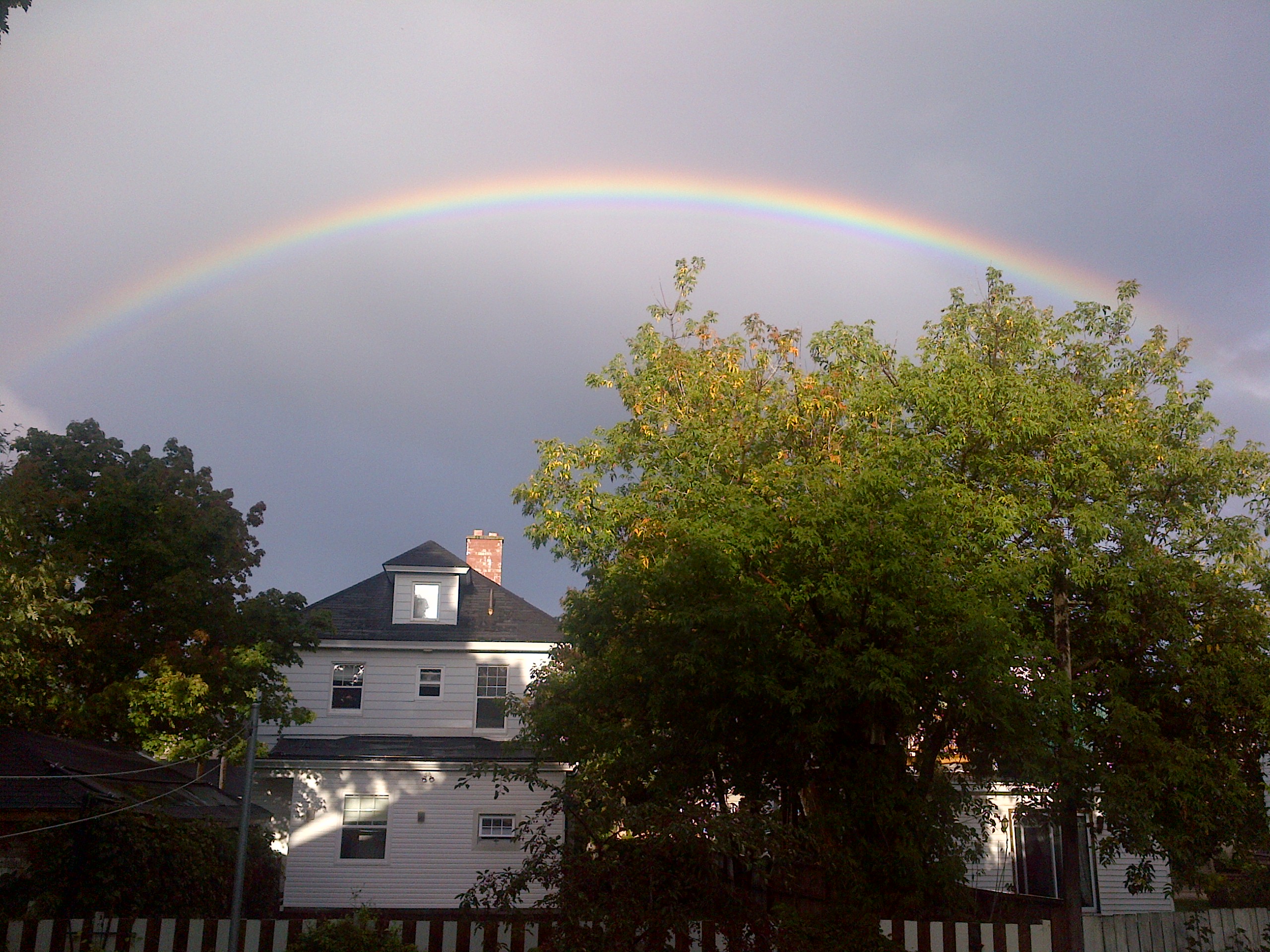
Are the kids actually all right?

Whence the minions came to me, seeking my munificence as laird of Bruce manor, I said unto them: “Daughters, kneel close, for I shall not sayest unto thee again.”

And so they did.

“Uh, Dad,” one queried, “What do you want?”

The other one, loaded with homework, merely uttered, “I don’t have time for this. . .Can you write me a letter, or something?”

I bellowed, as befits the King of the Castle, Nay! “Now here’s the deal: I command you both to become print journalists. In this way, you will carry on a valiant tradition – now three generations in the making – of making no money, subjecting yourself to the whims of editorial style, and becoming a self-loathing supplicant of various chain-store media flavors. Oh, and by the way, you should go to college poste haste, rack up enormous debt to prepare yourself for the life of which I speak, and spend the rest of your productive careers looking for good gigs interviewing rappers and garden ladies on CBC. Sound like a plan?”

Oddly enough, my minions don’t remember any of this – most likely because none of this actually happened, except, perhaps in my own feverish brain on a night when I had hoped that I would be heard, considered and then, finally, dismissed as any kind of example.

Indeed, if you read a recent RBC report you discover that “parents underestimate the influence they have over their children’s education. . . While 28 per cent of students say they chose the program they’re in to please their parents, only 21 per cent of parents think they have this influence. What’s more, when it came to deciding whether or not to go to post-secondary school, 10 per cent of students made this decision to satisfy their parents, but half as many parents felt the same.”

I’m reasonably certain that when I decided to go to Dalhousie University and study geology, physics and math in the late 1970s, it was not to please my artistically inclined, journalistically bent parents who – upon hearing my freshman-year course selections – could barely contain their mirth. As it happened, within a year, I had joined them in the general, family giggle.

Yet, I do remember my father and mother encouraging me to follow my dream, whatever it was, in my young life.

I also remember telling my own kids to do the same. One is now an analyst in early childhood education. One is a practicing veterinarian.

Says Mandy Mail, director of Student Banking at RBC Royal Bank: “From choosing which school to attend to selecting a program, students are making decisions to please their parents. It’s important for parents to maintain an open line of communication to ensure students are being thoughtful with their approach and to help ease the stress and encourage a more optimistic outlook on their future.”

Well, Mandy, with all due respect, that just sounds like another speech from another throne situated on a podium to which both students and their parents come to worship, hoping to score the bucks necessary to fill the banking industry’s notion of mortgage-worthy success.

Here, young ones, have another interest-free credit card. Do your university courses dovetail with our actuarial tables predicting income success? If so, have another credit card. Have three.

Come minions; come to us. We’re not your mum or dad. Worship at the feet of the real King of the Castle, mammon.

Unlike your parents, who love you unconditionally and support just about any direction you choose, we’re simply waiting at the crossroads.

Tagged ,

New Brunswick’s surging orange crush

DSC_0028

For a while here, on the East Coast, it seemed that the federal Liberals could do no wrong. They had a majority approval rating of nearly 50 per cent in the run-up to the national election. They had a youthful, passionate and sometimes articulate leader in the body of Justin Trudeau.

But at some point between the time the writ dropped and the last summer barbecue ended, a funny thing happened on the way to the ballot box: Atlantic Canadians lost faith in the ability of a red tide to subsume the prevailing blue wave. Now, some are talking about an orange crush, Quebec-style.

This turn of events frankly amazes Don Mills of Halifax-based Corporate Research Associates, whose company conducted the latest survey of public opinion. “It’s all very close now within the margin of error for (the Conservatives, Liberals and NDP),” he told the Brunswick News organization last week. “New Brunswick is starting to look a lot like Canada. It’s going to make it a lot more competitive than, perhaps, it has been in the past.”

According to his most recent results, “Support for the federal New Democratic Party (NDP) has increased once again this quarter. . .Four in ten decided and leaning voters in Atlantic Canada support the Liberal Party of Canada (40 per cent, compared with 43 per cent of decided voters three months ago), while one-third prefer the NDP (33 per cent, compared with 29 per cent decided voters).

“Meanwhile, backing for the Conservative Party of Canada is consistent with last quarter (22 per cent, compared with 24 per cent of decided voters), while four per cent of decided and leaning Atlantic Canadians prefer the Green Party of Canada (unchanged). One-quarter (25 per cent, down from 41 per cent) of residents in the region are undecided, refuse to state a preference, or do not plan to vote.”

What’s more, Corporate Research’s results show that “Conservative Party leader Stephen Harper’s popularity currently stands at 17 per cent (compared with 19 per cent in May 2015). Meanwhile, Justin Trudeau of the Liberal Party is preferred by three in ten Atlantic Canadians (29 per, down from 36 per cent), while preference for Thomas Mulcair of the NDP increased to one-quarter (27 per cent, up from 22 per cent), and Elizabeth May of the Green Party is preferred by seven percent (up from 5 per cent).”

As for New Brunswick, specifically, the numbers shake out this way: Twenty-seven per cent of those surveyed are “completely dissatisfied” with the Harper government; another 30 per cent are “mostly dissatisfied”; only 31 per cent are either completely or mostly satisfied. That’s a ratio of nearly two to one against returning the incumbents to office.

As for leadership preferences, the results are even more compelling. On the question, “Which one of the following party leaders would you most prefer as Prime Minister of Canada?”, New Brunswickers answered thusly: Thomas Mulcair of the NDippers, 27 per cent; Mr. Trudeau of the Grits, 22 per cent; Mr. Harper of the Tories, 21 per cent.

Of course, there’s much turf yet to be covered in this horse race. Still, as Mr. Mills’ research indicates, “A majority of Atlantic Canadians continue to be dissatisfied with the current federal government. Two-thirds of residents (66 per cent, as compared to 63 per cent in May 2015) are dissatisfied in this regard”

All of which may not suggest an actual, Quebec-style orange crush for the NDP in New Brunswick next month.

But the chances of a blue day for the Conservative Party are certainly improving.

Tagged , , ,

Life’s certainty: debt and disappointment

IMG-20120908-00198

For more proof that the federal government lives in a black box, coated with bubble wrap and buried in the deepest antechamber of Parliament Hill, look no farther than the hosannas it raises over the Finance Department’s latest projection that the country has posted a razor-thin surplus of less than $2 billion.

Apparently, this announcement is designed to cheer a worried populace, convince the nation that the Harper plan for “careful economic stewardship” is working and that, thanks to cunning and perspicacious policy at the centre, the regions may expect bread, honey and wine in the years ahead, if only they would get with the political program.

How, one wonders, does this logic track in Alberta, where provincial finances have been decimated in recent months thanks to a federally supported campaign to link that province’s economic prospects to fossil fuel prices it does not, and never has, controlled? How, indeed, does that constitute “careful stewardship”?

How, furthermore, does the argument persuade the people of Newfoundland and Labrador, Manitoba and Ontario that their astonishing fiscal woes can be ameliorated by the actions (or, more precisely, inactions) of a federal partner in Confederation that has been absent without leave for, lo, these many, nine years?

How, indeed, do we reconcile such claims with the very real possibility that New Brunswick will find itself unable to cap its impressive operating deficit (now in the hundreds-of-millions-of-dollars), let alone pay down its long term debt (now above $12 billion)?

If we lay these burdens at the feet of the federal government, we have good reason.

That so-called national “surplus” has been bought and paid for by the provinces and territories that have been forced to endure broad caps to public spending on traditional, nation-building priorities, including: health care, public education, university research and development, arts and culture, and workforce skills development and placement.

To be sure, this does not, and should not, let New Brunswickers off the hook for their own prettily arranged economic malaise.

Over the years, we have been more than willing to demand of our provincial governments everything we’ve always believed we had a right to expect: low taxes, high-quality public services, good jobs, seasonal employment combined with fully funded, no-questions-asked employment insurance.

Still, lurking beneath the surface has been a federal administration that has evinced very little interest in the conditions of the places where people actually live and work and raise families – and even less interest in building long-term economic capacity where it matters most.

In contrast, an enlightened national government would spend time getting to know the provinces with which it is obliged to partner. It would reach out to extend the enormous capital and human resources at its disposal to build a true and durable national consensus on social and economic priorities.

It would not shut down debate in Parliament, relegate important committee work to busy work, demean the democratic process by burying every important issue into an omnibus bill, and demonize every principled, conscientious objector of its priorities and plans as effective enemies of the state.

It would not refuse to extend humanitarian relief to those who are, heartbreakingly, unable, through no fault of their own, find succor and solace elsewhere in the world.

We, in Canada, do not live in a black box, coated with bubble wrap and buried under Parliament Hill.

We, in New Brunswick, and in every other province and territory of this once-noble country, live in the light with our hearts nobly bleeding, our hands generously outstretched.

So should our federal government.

Tagged , , , ,

Becoming who we must be

DSC_0026

The general rap about New Brunswick is that it is a minor principality of Canada, possessing neither the breathtaking vistas of Cape Breton nor the urban sophistication of Halifax nor even the vital, village atmosphere of Newfoundland and Labrador.

As for comparisons with Prince Edward Island, “fuggedaboutit”, as the New Yorkers say. That province has received so much federal money since God created the East Coast, there’s just no point in competing with it for tourists or, as the case may be, aerospace money.

Still, there are a few things demonstrably good about the “picture province”.

We are, for example, good with potatoes. In the early 1950s, a couple of middle-class brothers from Florenceville invented a way to harvest, process, and sell frozen French fries. Within a couple of decades, Wallace and Harrison McCain had conquered the world for these tasty treats. Today, their descendants operate a $5-billion a year conglomerate, employing nearly 25,000 people on six continents. Not so bad for a boring stopover, a la New Brunswick, en route to somewhere more, we shall say, exotic.

We are also good at oil and gas refining, having mastered the craft through the diligent efforts of the Irving family in Saint John. In fact, that outfit in New Brunswick’s “Port City” is among the most sophisticated in the world. Recently, the company announced that it would, according to a CBC report, “spend $200-million and employ up to 3,000 workers over 60 days to upgrade existing processing units at the New Brunswick plant. The Saint John facility is Canada’s largest refinery.”

Beyond this, we’re preternaturally good at making technological infrastructure and producing entrepreneurial options to traditional resource industries. We are, and have been an early-stage incubator (mostly for Information Communications applications) for innovations that have been exported and implemented across North America and around the world.

Lamentably, what we have not always been good at is blowing up the silos that separate us from the rest of this country and, in fact, from ourselves – the ones that keep the rural north and the urban south apart; the ones that cultivate differences between the three, major urban centers of Fredericton, Saint John and Moncton; the ones that persist between First Nations and non-aboriginals; and (surprise, surprise) the ones between Anglophones and Francophones in the nation’s only, officially bilingual province.

Maybe the worst thing we do is to make a meal of systemic mistrust of our own political representatives and public institutions. Our inability to get together to solve our joint economic and social problems has been our biggest problem – the only intractable hurdle that has held us back for 100 years or more.

Still, New Brunswick has produced some of the smartest men and women in the global room. Many have actually understood their responsibilities to the their fellows; they have decided not to break the world they helped build.

One of them is Donald Savoie of the University of Moncton. Another is David Campbell, chief economist of New Brunswick.

Still others include: Louis Leger, Mario Theriault, Ben Champoux, Nancy Mathis, Aldea Landry, and Brian Murphy.

All have spent their productive lives pondering the productive question about this province, about their communities: How do we come together?

How do we blow up the silos that separate us and render us vulnerable to those who continue to retail the general rap about New Brunswick?

The questions are crucial. The answers are vital

Unless we know how to become, how will be ever know what we must be?

How do we become who we must be?

Tagged , , , , , , ,

Dancing in the light

DSC_0074

A word to the wise: A daily, six-kilometer fast walk and a nightly, 45-minute endurance routine on a floor mat does not prepare a 55-year-old body for a sudden dismount from a handstand – especially if said body lands on its tippy toes, like Baryshnikov on a really, really bad morning.

“CRUNCH!” was the sound heard round the living room of the Bruce family homestead in Port Shoreham, Nova Scotia, on Labour Day.

To be clear, this was not morning and I cannot confirm or deny the presence of certain liquid substances at the ready to lubricate the traditional, family dance party that, thanks to a wide variety of eclectic music on hand, tends to drown out the yipping and yapping of the ever-increasing population of coyotes in that dark, starry Guysborough county of the Maritimes.

What I can confirm is the solicitude of my wife, sister, brother-in-law, niece, nephew, and a close friend from England. We had been dancing for hours, affecting every style – from punk, to doo-wop, to head-banger, to ballroom, to the hokey-pokey – before I managed in one fell swoop (literally) to crack my foot.

“I think it looks dislocated,” my wife helpfully advised, having surveyed the 90-degree angle the big toe on my right foot had assumed.

“Maybe, you could pop it back in,” my nephew offered.

“I don’t think it’s broken,” my niece observed. “Can you move it?”

I looked at all of them as if they were terrorists intent on hobbling me forever. (After all, my dance moves put them all to shame. . .ahem).

“Look away,” I instructed. “I will handle this.”
And so I did. I grabbed the offending appendage and hauled it over to the neutral position. “CRUNCH!”, again, was the sound heard round the living room. And the dancing continued, as it most certainly should have (sans moi, bien sur).

In fact, there is no better way to appreciate the Maritime spirit than from a reclined position. The odd mood of contemplation that injury and humiliation engender is a priceless asset in the ancient effort to get back onto one’s feet.

Sitting there on the couch, watching them all dance like fools, I remembered why my wife and I and our grown children, with children of their own, fully appreciate this part of the world.

This is where the main chance hits the yellow brick road. This is where fantasy meets reality and you slide down the rabbit hole with both. This is when, the moment you think you’ve got everything nailed down in Bristol fashion, you break your foot.

It’s happened before in this region; it will happen again.

The trick is to ice that part of our Maritime souls, to exercise it, to nurture it, to believe in its recovery – in its sturdy capacity to surge ahead even, especially, when it’s injured.

In a nerdy sort of way, I recalled a passage from the 2014 Ivany Report in Nova Scotia: “While the continuing retreat of the federal government from a regional development role and fiscal weakness at the provincial level are serious constraints, the single most significant impediment to change and renewal is the lack of a shared vision and commitment to economic growth and renewal across our province.”

Yup, say it brother.

“How’s the foot?” my niece inquired. “Can you move it yet?”

I smiled and said, “Shall we dance?”

And so we did, in the light of a strong moon, a starry sky and the company of family. She pranced like a gazelle; I limped like a troll.

But, at least, we danced.

Tagged , , ,

Leveling the playing field

DSC_0066

Speaking truth to power doesn’t guarantee that the ears of the privileged among us will open. But they will almost always burn – and in a delightful reddish hue, no less.

Charles Murray’s job is, thank goodness, to afflict the comfortable. In fact, as New Brunswick’s Ombudsman, he gets paid to swing away at provincial Crown corporations like WorkSafeNB, which is precisely what he did last week in a closed-door meeting with a blue-chip panel of experts which is reviewing the legislation that covers the Worker’s Compensation Act.

Specifically, according to Mr. Murray’s official website, “The Ombudsman is an independent officer of the Legislative Assembly who investigates complaints from the public about New Brunswick government services. Ombudsman offices are present throughout the Canadian provinces and their services are free”.

Indeed, “The New Brunswick Ombudsma’s Office has one central mission: to ensure that all New Brunswick citizens are treated with administrative fairness by government and its agencies. The Office strives to guarantee that individuals are served in a consistent, fair and reasonable manner by provincial governmental organizations.”

As for WorkSafe, Mr. Murray is blunt. “In a rather fundamental way,” he said in his presentation, which is posted to his website, “it is our strong impression that WorkSafe’s present calibration, if I may use that word, is proving less equitable to injured workers than it should.”

He elaborates: “For the worker, the injury represents a deep, life-changing, and fundamental challenge to their ability to live the sort of life any of us would wish, both for them and their families. It touches them very deeply. The injury is a blow to financial and emotional security for them and their loved ones. It also may, at the very time of this challenge, diminish their mobility, their ability to perform their daily tasks and hence their available time. The injury itself, the medication needed to treat it, and the stress and trauma of the accident and the uncertain future may also compromise their mental health.”

On the other hand, the company that employs the injured worker “faces no such existential crisis. Its challenge in finding a replacement worker or in reallocating duties may be more accurately described in terms of degrees of inconvenience.”

How has equity and fairness drifted over the years? Mr. Murray invites his audience to “look at the imbalance another way. Any government agency which interacts regularly with powerful, articulate and monied interests in the private sector risks over time being persuaded to shift its perspective towards that interest.”

In fact, he warns, “If regular self-examination is not conducted, agencies may find themselves what is termed ‘captured.’ They become so used to seeing the world in a certain manner that they lose the ability to see the invisible ways in which they are favouring one side of the balance they are tasked with ensuring.”

Naturally, WorkSafe’s president, Gerard Adams, is buying none of what Mr. Murray is selling. In a statement, reported by the Telegraph-Journal, he expressed his surprise and disappointment with the Ombudsman’s statements.

Still, is it dramatically difficult to believe that institutional inertia does, over time, favour the status quo, which, in turn, favours the powerful and the privileged?

This is not necessarily a deliberate attempt by individuals to favour one party over another. In a sense, the problem would be easier to fix if it were engineered that way.

This is the way of the organizational world; the banality of evil is, sadly and all too often, bureaucracy.

That’s why guys like Charles Murray still have jobs afflicting the comfortable.

Thank goodness.

Tagged , ,

Trials by fire

DSC_0058

Rare is the politician who, recognizing the error of his or her ways, genuinely seeks to make amends.

That’s not to say that elected officials are loath to apologize for their statements or behavior. In fact, a tendency toward issuing unnecessary mea culpa passes in and out of political fashion with reliable frequency.

But an authentic reversal of policy in the wake of public criticism almost never happens unless an election looms. In New Brunswick, at least, another trip to the ballot box is years away.

And so it was, not long ago, that Premier Brian Gallant and Social Development Minister Cathy Rogers abandoned plans to dun relatively wealthy senior citizens in the province to help defray the cost of nursing home care for the rest.

“We will be cancelling the policy, pressing the reset button,” the premier said at a news conference in Moncton.

Added Ms. Rogers in a statement: “While the policy was designed to make care more affordable for the majority of seniors, it is clear that the announcement . . .caused a significant amount of concern for seniors. This was not our intention nor was it consistent with our priority of helping seniors and their families.”

In fact, methinks the not-quite-invisible hand of the minister had more than a little something to do with the premier’s change of heart. Indeed, his capitulation was not without a certain archness. “Taking this policy off the table,” he said, “does not mean our challenges go away.”

Still, Ms. Rogers’ background and sensibilities suggest she is more comfortable working with seniors to achieve at least some degree of consensus than dictating the terms of their surrender to economic realities in the province.

According to her official biography, she’s “a graduate of the University of New Brunswick with a masters and a Ph.D. in Sociology.” She served “14 years as professor at Crandall University and University of New Brunswick.”

What’s more, “With a policy focus on child and youth poverty, she understands the connections with health, education, crime, and the economy. (She) spent 18 years as a federal and provincial civil servant working in social development, industry, public safety, and economic development.

“She has been a lifetime advocate for prevention, support, and early intervention, and is concerned for the quality of life and well-being of vulnerable families. Honoured for her community service work by the YWCA Moncton in 2011 with a Woman of Distinction Award for Education, Training, and Development, she also received Stephen and Ella Steeves Excellence in Service Award from Crandall University in 2012.”

Given the complexion of her personal and professional achievements, inciting revolt among the province’s elderly – the fastest-growing demographic here ­– would not be an especially flattering footnote to her resume.

In truth, though, the whole idea of raising fees for some folks – a measly haul of maybe $1.6 million to government coffers – to help pay the costs of others, based on a largely arbitrary means test of personal wealth, was ludicrously provocative and unworkable from the get-go. Its only productive result has been to arm the opposition Tories with mud to sling, as Progressive Conservative leader amply demonstrated in his reaction to last week’s policy about-face: “The premier and the minister have bungled this from the start. They should have apologized to seniors for putting them through this for the past six months. Minister Rogers needs to take responsibility and resign.”

Of course, Minister Rogers needs to do no such thing. She will be far too busy continuing to make amends among the one voter block whose members still reliably line up on Election Day.

Tagged , , , ,

Bridge over troubled waters

DSC_0073

Local activists spent decades twisting the right arms of federal politicians getting approval, five years ago, for a full-time, functioning fish passage through the causeway that connects the communities of Riverview and Moncton across the Petitcodiac River.

Now, it’s time to twist their left ones.

Provincial Transportation and Infrastructure Minister Roger Melanson may be a tad opportunistic (this being an election season, and all) when he asks national party leaders what, if anything, they intend to do about the second phase of the river’s planned restoration – a bridge that will replace a significant chunk of the existing fixed link – but he’s not wrong.

The permanent gate-opening has produced efficacious results that not even the most optimistic of riparian ecologists could have predicted back in 2010: The river is dramatically wider around The Bend; fish species have returned in droves; and the famed tidal bore has never been higher.

As a result, tourists have once again designated the banks of Atlantic Canada’s Big Muddy a choice destination on their calendar of things to do when hanging about southeastern New Brunswick in summertime.

Long-board surfers from California now routinely make the 6,000-kilometre trek, from their sun-bleached bivouacs, to “ride the tide” from the Petitcodiac’s mouth, near Fundy Bay, to the shores of Riverside Park (a 90-minute journey, by some accounts).

One of my sons-in-law – a marine biologist with a masters degree in environmental management, and as avid a surfer as God ever made – had never heard about the river’s “tidal bore, version 2.0” until he saw a lengthy clip on You Tube a couple of years ago.

“Alec,” he told me, “You know, I just have to do that.”

I have no doubt that he will.

All of which points to the obvious truth: When a community heeds, and invests in, the integrity of its natural splendors, the local economic impact can be as substantial as twinning a highway.

According to Parks Canada’s website, nationally protected areas make “a substantial economic contribution to (the country’s) economy. Through the spending of the organization and the visitors to Parks Canada’s National Parks, National Historic Sites and National Marine Conservation Areas, a significant and widespread economic impact is felt throughout the country.

“In 2008/09 Parks Canada’s organizational spending and visitor spending totalled $3.3 billion. Of this amount, visitor spending accounted for $2.7 billion and $587 million was spent by Parks Canada on three program areas. The overall national economic impacts derived from the spending attributed to Parks Canada on the Canadian economy are: Gross Domestic Product, $2,988 million; labour Income, $1,925 million; employment, 41,720 fulltime equivalents; tax revenue, $218 million.”

By my calculation, that’s a four-to-one return on public investment, which renders Parks Canada one of the most successful “businesses” in recent Canadian history.

Why, then, can’t the same logic be applied to the Petticodiac River – surely one of the most deserving heritage sites in this country that has not actually received designation?

It would begin with a bridge over the waterway where the causeway now stands. That edifice, with federal support, would further facilitate the natural flow of the river. Eventually, silt and mud would find their way to the coastal estuary and out into the sea.

Meanwhile, our duly protected riparian banks would become magnets for the environmentally sustainable development of public spaces – especially those that would support and augment a new downtown events centre complex.

In 20 years, or less, we might just well engineer a world-beating river restoration and find, to our astonishment, that we did something right.

Indeed, no arms needed to be twisted.

Tagged ,

Daycare is child’s play

IMG_0261

For Ted Melhuish, authenticity is tantamount to, well, the genuine plate of Caribbean cuisine he was evidently relishing at a restaurant in downtown Fredericton.

It was early April 2013, and the tempests of a hard Canadian winter had abated just long enough to allow the sun to shine and the mercury to rise above 25 degrees.

He smiled like a kid in a candy store as he stuffed a bit of Jamaican jerk into his mouth. “Oh yeah,” he says. “It’s good. . .It’s very good. . .very original.”

Dr. Edward Melhuish is all about originality, reality, genuineness and authenticity. In a way, one might say, these qualities of mind have been his stocks in trade for more than 30 years. As his University of London (U.K.) biography stipulates, he “is Professor of Human Development at Birkbeck, University of London, and Visiting Professorial Fellow at the Institute of Education, University of London.”

He is also an “internationally recognized expert in the study of child development and childcare (who) has extensive experience with longitudinal studies. He was a Principal Investigator of studies of day care and family life in the 1980s, which had considerable influence on sections of the 1989 Children Act (U.K). He has also conducted research on child development, parenting and childcare in several European countries, on behalf of the European Commission.”

What’s more, “For several years Professor Melhuish has been a Principal Investigator on the Effective Provision of Pre-school Education (EPPE) in England and Effective Provision in Northern Ireland (EPPNI), which are following 4,000 children.”

Finally, “Professor Melhuish has acted as a consultant for the design of children’s organizations (e.g. UNESCO), government departments and film, television and radio companies. In addition he has frequently contributed to the media on children’s issues, including newspaper, radio and television programmes.”

In this context – that of a visiting scholar, educated in all matters related to early childhood education (ECE) – it’s worth noting just how far apart academia and actual practice has become in this province. After all, how many Professor Melhuishes has New Brunswick produced over the past three decades?

Instead, we face a risible crisis in ECE produced by broad ignorance about its benefits, suspicion fanned by federal and provincial governments, which seem to think that wedge-issue politics trumps the welfare of our children, and a calculable lack of expertise in the field.

In fact, a recent investigation by reporters of this newspaper group has found evidence of downright despicable conditions in New Brunswick’s regulated daycare operations: “In one year of visiting (these facilities) inspectors found guns, mouse droppings, lighters left out within children’s reach, and fighting on the playground with no one around to intervene.”

Worse, the report stipulates, you, dear reader, will not “find any details about these problems on the government’s online daycare inspection registry. Until now, violations in publicly licensed daycares have been kept largely secret from the public.”

Whether this secrecy was generated by fiat or general bureaucratic neglect hardly matters.

Nothing in our society should concern us more than the early childhood education of our offspring. After all, our kids will someday rule the planet, and how they govern in the future depends entirely on how we help them think and work and play today.

We have it, within our power, to create builders or destroyers, peacemakers or warmongers, physicians or psychopaths.

It is, as Professor Melhuish says, entirely up to us.

Shall we order in educational take-out tonight?

Or shall we make a good meal from a delicious pairing of ingredients in our own authentic land?

Tagged , ,

What’s wrong with this picture?

IMG_0809

As a resident of this fair province, New Brunswick, it’s a hopeless comfort to know that while the rest of Canada slips quietly into recession, I may expect to keep my head above water and even thrive during the two minutes it takes me to attach the absurdity filter to the worn and threadbare spectacles I use to read the morning headlines.

So it was the other day when I came across this marvelous series of proclamations from New Brunswick’s finance minister, dutifully reported in the pages of provincial newspapers:

“Nationally, we’re in a recession and Stats Canada has confirmed it,” Roger Melanson said some days ago. “So we will continue to monitor the situation on a quarterly basis. That’s why we have quarterly updates. It’s the tool we have in terms of making the information public so New Brunswickers are fully aware of the state of our economy.”

Yet, his finance department boldly predicts an annualized growth rate in the province of between 1.5 and 1.7 per cent next year. Why? Because the economic auguries say so? Because the entrails of road kill on the Trans-Canada are aligned just so? Because the tea leaves in the lunchtime cups left on the cafeteria tops at Freddy Beach suggest better times ahead?

How bluntly irrelevant Minister Melanson’s claim is – especially when you consider that most New Brunswickers are already fully aware of the state of their economy. Indeed, as the nation dips into recession, this province has never managed to crawl out of a long, agonizingly slow one.

The essential quandary is: Do we care?

Go back into history see the same ludicrous patterns repeating today: A province whose economy is bifurcated by rural and semi-urban sensibilities; an institutional sector that will protect its turf at the expense of the students, professionals, patients, and citizens it purports to represent; a political culture whose last, good idea for meaningful change died when the New Brunswick inventor of kerosene did.

The agony that Mr. Melanson does not address when he talks of scraps of GDP improvement in this province in this year is the long, slow dissolution of self-reliance, self-improvement, and enthusiasm in this province.

Where are the monumental projects of imagination?

Who will build the next generation of entrepreneurs willing and ready to break the molds crafted by their forbears?

What new cohort of young people, coupled to older folks, stands to step up in this province to usher a renaissance of economic, social and political principals and priorities?

These are the questions that political leadership in this province should pose. Instead, Mr. Melanson seems content to rely on the predictions of statisticians and economic actuaries to spin a wobbly tale of good news about New Brunswick’s prospects.

“It’s important to note,” he says, “that every province, including us, have adjusted their GDP projection based on growth. . .(With the exception of Prince Edward Island) we’ve all brought it down because of the national situation economically. But we still have to keep in mind that there are sectors of our economy in our province where we have seen positives.”

T’was ever thus, perhaps. But our present condition demands sterner stuff from our elected representatives, appointed bureaucrats and, in the end, us.

Our future cries out for it.

Canada’s national recession may be a lamentable circumstance; ours, in New Brunswick, is a state of mind.

We have, in this province, only two avenues: becoming or calcifying.

We either fossilize or shunt the ties that bind and live in hope.

Through my threadbare spectacles, I choose hope.

Tagged , ,