Tag Archives: Rob Ford

Hog Town’s Ford farce on world tour

DSC_0162

The world, it seems, cannot get enough of Toronto’s very own booze-guzzling, crack-smoking Falstaff. And he of coarse demeanor and rotund comportment is more than happy to oblige his growing audience.

“Yes, I have smoked crack cocaine,” Rob Ford admitted on Tuesday. “There have been times when I’ve been in a drunken stupor. That’s why I want to see the tape.

I want everyone in the city to see this tape. I don’t even recall there being a tape or video. I want to see the state that I was in.”

So, then, he was lying in May when he declared: “I do not use crack cocaine, nor am I an addict.” Not exactly, hizzonner said this week: “I wasn’t lying. You didn’t ask the correct questions.”

On the broadest interpretation of this point, if on no other, Mr. Ford is right. We in the media rarely ask the correct questions. If we did, then one question we might want to ask now is: Why is Hog Town’s chief magistrate enjoying a bump in this personal approval rating among municipal voters just as his confession to truly bad behaviour is transforming him into an international media darling?

To restate the question: Have we all lost our minds?

Chris Batemen, a staff writer at blogTO, has compiled a compelling assortment of  news items about the fine fellow from the world’s press. From his research, we know that Esquire has expressed an interest in Mr. Ford’s manners while under the influence of substances, illegal or otherwise.

“As it turns out, the mayor may have been the very model crack house guest, Charles P. Pierce blogged. Referencing original reporting by The Toronto Star, Mr. Pierce links directly to a November 5 story which observed, among other things, “The City of Toronto has refused to say whether Mayor Rob Ford paid utility bills for the Etobicoke crack house where he was photographed with three alleged gang members.

But a city official has confirmed that on January 7, Chris Fickel, one of Ford’s special assistants, called the city’s water department on behalf of resident Fabio Basso regarding a sewage issue at 15 Windsor Rd., said Toronto Water manager Lou Di Gironimo. . .The bungalow. . .is home to the Basso family, including Ford’s old friend Fabio Basso and his sister, convicted cocaine trafficker Elena Basso, who also, according to the police document, has a conviction for prostitution.”

Meanwhile, Stephen Marche wrote on the opinion pages of The New York Times, “The old clichés are beginning to fall away from the city where I live. What has happened to Toronto the Good? Where is ‘New York run by the Swiss’? Mayor Rob Ford’s crack smoking. . .is only the most extreme example of his recent illicit adventures. Perhaps the most telling anecdote from a police file that surfaced late last week involves Mr. Ford’s heading into the woods with his buddy Sandro Lisi, currently out on bail after being charged with extortion, and leaving the pathway strewn with bags of empty vodka bottles. His mayoralty has been an experiment in what would happen if you had a feral 16-year-old boy for mayor.”

Then there’s Rolling Stone’s Tim Dickinson, who has helpfully added Mr. Ford’s name to the list of the magazine’s Top Five Political Excuses of All Time. He joins former South Carolina Governor Mark Sanford, former New York Congressman Anthony Wiener, former mayor of Washington, D.C., Marion Barry, and former Idaho Senator Larry Craig.

Yes, yes, it’s all so very amusing. One wonders what Mr. Ford plans for a second act. A blood-letting for Heroine addicts at Nathan Phillips Square? It’s not as if he’s going anywhere, anytime soon. He loves the limelight. Indeed, in his fevered mind, his personal disgrace actually becomes him. And, absurdly, Toronto possesses no mechanism for booting him from office.

There is, of course, another audience who is not as rapt about the boy: It’s comprised of those who, like me, were born in the downtown and raised there. We can’t wait for City Hall to get back to work before the Gardiner Expressway finally crumbles along with Mr. Ford’s credibility.

Tagged , , , , , ,

Pot’s “cool” factor is fading fast

DSC_0074

Never to be outdone – especially not by a Liberal usurper to the parliamentary throne – Toronto Mayor Rob Ford (how is that guy even alive?) now professes to have smoked pot. Whereas Justin Trudeau confirms that he has sucked back on a spliff maybe six times in his life (yeah, right), Hog Town’s burgemeister giggles, “Oh yeah, I won’t deny . . .I smoked a lot of it.”

Given his performance in office, that particular admission is not likely to cheer those who insist that marijuana does not impair one’s judgement. Still, he does appear to be in good company.

Ever since Mr. Trudeau’s calculated announcement this month, elected officials from all points on the political spectrum have been fairly tripping over themselves to cash in on this newest “cool” factor in Canadian politics.

Ontario Premier Kathleen Wynne says smoking pot is among the “personal decisions that people make. I’m not going to weight in on a decision of another politician or individual.” As for her own “personal decisions,” she adds, “I have smoked marijuana, but not for the last 35 years. . .and certainly not since my children were born. It has never been a big part of my life.”

Liberal MP Wayne Easter says, “Yes I tried it once about probably 40, 45 years ago now and once what enough for me.”

His colleague Sean Casey explains, “I did as a teenager, I tried it couple of times. I didn’t like it, I was never a smoker and I hacked and coughed so much it didn’t do anything for me, quite frankly.”

Meanwhile, Liberal MP Lawrence MacAulay sounds almost ashamed when he admits “I have never smoked marijuana. . .Well I guess down in Magel it was hard to find. I didn’t know much about it back then.”

It’s the same species of answer that Nova Scotia Liberal Leader, Stephen McNeil, gives when he says he, too, is a virgin to weed: “It probably has something to do with a mother who was a sheriff and five brothers who are law enforcement officers.”

Ontario Progressive Conservative Leader Tim Hudak was actually out front on this issue back in 2011 when he volunteered, “I was a normal kid, I had a normal upbringing, a normal life in university. I experimented from time to time with marijuana. In other words, it was nothing to write home about in the “grand scheme of things.”

At around that time, U.S. President Barack Obama cracked up the Washington press corps when, in response to a question about whether he ever inhaled, he declared: “Frequently. . .That was the point.”

As a Wikipedia entry points out, “Prior to prohibition, U.S. politicians known for growing cannabis include some of the nation’s Founding Fathers and Presidents.” There’s Benjamin Franklin, Thomas Jefferson, Andrew Jackson, and James Madison. There’s also Franklin Pierce, Zachary Taylor and George Washington.

More recently, since pot’s interdiction, a virtual bevy of prominent baby boomers have admitted to using the stuff, including Bill Clinton, Jesse Ventura, Arnold Schwarzenegger, and the current U.S. Secretary of State John Kerry.

All of which raises the question: How cool can something be if everyone is (or was) doing it?

I was roundly considered a nerd in high school in large part because I refused to  toke up. I wish I could say this was one of my principled stands. The truth is I didn’t like the smell, though I didn’t (still don’t) begrudge anyone else’s decision to partake.

The legal alcohol I consume actually makes me more of an outlier (if not an especially cool one) than the marijuana some of my friends and associates smoke. I’m edgy and dangerous, flirting with disaster. In contrast, they’re all too bloody normal, even, dare I say, conformist.

Rob Ford – who has been lambasted in the press for his alleged appearance in a video with drug dealers and his infamous declaration, “I do not use crack cocaine, nor am I an addict of crack cocaine” – wonders why all these politicians “are all coming out” regarding their use of marijuana. It is, he seems to suggest, no big deal.

For once, he’s dead right.

Tagged , ,

Mayors set vastly different examples


Sitting while burgermeistering turns the Twitterverse agog, we say

Sitting while burgermeistering turns the Twitterverse agog, we say

It is with a certain chill that one wonders how Toronto Mayor Rob Ford might have handled flood-ravaged Calgary had he been the burgermeister of that fair, if water-logged, city.

Would he have blamed the heavy rains and bursting riverbanks on left-wing conspirators determined to prove that climate change is real? Would he have taken the opportunity to sweep the streets clean of the homeless and disenfranchised, relocating them by means of bus and pick-up truck to the ex-urban hinterland? Would he have headed for the high country to wait out the storm with nary a peep of support for his fellow citizens, the ones he left behind?

However he might have managed the emergency – which is, by no means, over – one suspects his response would not have come close to matching the gold standard set by Calgary’s actual Mayor Naheed Nenshi, whose status as hero seems secure for all time. The Twitterverse loves the guy, and for good reason.

No finer example of leadership in action currently exists at any level of government, anywhere in Canada. Mr. Nenshi’s instincts have been razor sharp: He’s been selfless, cogent, organized and, perhaps most importantly, available.

His advice to his community has fairly flowed with common sense.

On national television he said, “We live in this urban, cutting edge city but like everyone else we live in nature; we live in this world. I am very familiar with this river (the Bow). It is part of my heartbeat the way it is a part of the heartbeat of every Calgarian, and no Calgarian has ever seen it this high and this fast. . .We can fix stuff, we can replace stuff; we can’t fix people.”

In one of his innumerable public updates, he declared, “I can’t believe I actually have to say this, but I’m going to say it: The river is closed. You cannot boat on the river. I have a large number of nouns that I could use to describe the people I saw in a canoe on the Bow River today. . .I am not allowed to use any of them.”

CBC News reports his Twitter feed as a litany of useful minutia:

“Latest update: water cresting, lots and soon. Stay away from riverbanks, stay tuned for further instruction.”

“Getting a first-hand look across the city. I’ve never seen levels this high and fast. Worst is yet to come.”

“And with that, a day that started 43 hours ago comes to a close. It included one plane, two helicopters and 3:45 am and 8:30 pm press briefings.”

“Did you lose precious family photos? Local photog @gabemcclintock offers to help make new memories.”

“Donate your grad dresses to young women in High River who lost theirs.”

“South line C-train service to downtown will be a while yet. We still recommend staying away from downtown if you at all can.”

“Big news: C-train service back in downtown tomorrow! Blue line back except city hall and centre street, NW line to 8th street.”

It’s often true that adversity brings out the best in people. But not always. Consider the sorry example Mr. Ford now sets in Hog Town, where his administration sits under a cloud laden with controversies, both minor and distinctively otherwise.

Did he or did he not smoke crack with known drug dealers? He refuses to sufficiently clarify the alleged circumstances as police continue to probe the matter. Meanwhile, his reputation stinks like burnt toast.

“Uh oh,” begins the blurb for a new Android gaming app called Stay Mayor.  “Looks like the Mayor’s in a buttload of friggin’ trouble with that alleged video of him smoking crack! And who knows if it even exists, amiright? But juuust in case, why don’t you help him collect a heap of cash to buy it before The Gawker does. Only your twinkle toes can out-maneuver the Blood Thirsty Media to help him collect more than they did in that damn ‘Crackstarter’ campaign. $201,255 to be exact. And hey, everyone needs a little boost now and then, so make sure you collect power up buckets of deep-fried courage for more footballs to throw at life’s problems. . .but make sure you avoid those pesky crackpipes!”

If all mayors are equal, then, some are more equal than others.

Tagged , , , ,

The tao of Toronto: Sickness becomes it

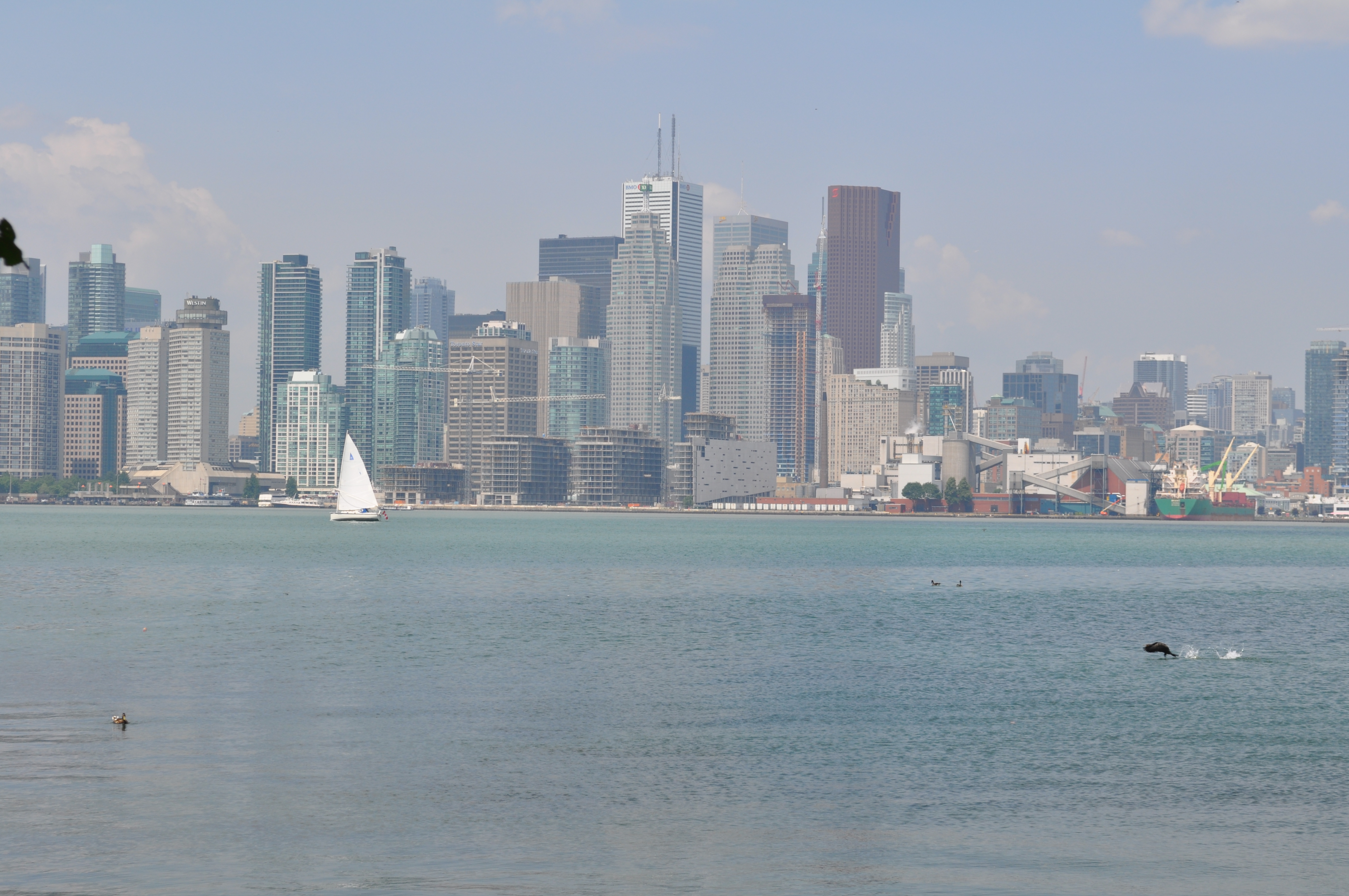
Toronto's mayor is as hazy as late afternoon look from Ward's Island

Toronto’s mayor is as hazy as late afternoon look from Ward’s Island

A mayor of a major metropolitan centre of Canada may skip a meeting of the Federation of Canadian Municipalities (FCM) for any number of reasons. He might, for example, be overwhelmed, juggling the urgent and competing demands of his office: negotiating with city workers, plotting the placement of new parks, fretting over the whereabouts of a certain video.

But Toronto honcho Rob Ford’s refusal to attend the FCM’s recent summit in Vancouver had more to do with principle than practicality. He just doesn’t like the cut of the organization’s jib, which, he thinks, luffs way too far to the left.

“Eighteen (Toronto) councillors flew out on Thursday,” he opined (according to the Globe and Mail) during this past Sunday’s edition of the radio show he co-hosts with his brother Doug, a Toronto councillor. “You know, the same councillors said ‘aw, you know, the city’s falling apart.’ Well where were they Thursday? Where were they Friday? You could shoot a cannon off at city hall.”

Mr. Ford’s implied contention that the FCM is a costly distraction from the real business of running a metropolis is oddly brave, given his own richly diverting circumstances these days. Beyond this, though, it misses the point. Canadian cities are, to varying degrees, facing serious challenges to their viability. And these challenges are, again to varying degrees, common right across the country.

The FCM is correct when it states in its 2013 Report on the State of Canada’s Cities and Communities that “The current division of powers encourages short term, informal and ad-hoc federal policies in the municipal sector, often designed without meaningful consultation with either municipal or provincial/territorial governments. The result is policies that respond to short-term political pressures and opportunities rather than address structural issues.”

The Federation wants Ottawa to “recognize the role of cities and communities in national prosperity, the challenges they face, and the national interest in vibrant, competitive and safe communities.” To do this, it demands a new deal with the feds that will “lead to the collaborative development of policies and programs that focus on those issues that remain unaddressed under outdated policies and jurisdictional obstacles.”

Those issues include: aging, even crumbling, transportation infrastructure; policing and public safety; affordable housing; and environmental protection.

The FCM’s 2012 report card notes that “a significant amount of municipal infrastructure rank between ‘fair’ and ‘very poor’—on average about 30%. The replacement cost of these assets alone totals $171.8 billion, nationally. . .More than half the roads surveyed fall below a rating of ‘good’: 32% are in ‘fair’ condition, and 20.6% are in ‘poor’ to ‘very poor’ condition, for a total of 52.6%”

Meanwhile, “A mixed picture emerges for wastewater infrastructure, with 40.3% of wastewater plants, pumping stations and storage tanks in ‘fair’ to ‘very poor’ condition, and 30.1% of pipes in ‘fair’ to ‘very poor’ condition. The replacement cost for the wastewater infrastructure in ‘fair’ to ‘very poor’ condition is $39 billion. . .With wastewater infrastructure now subject to new and more stringent federal regulations, even good or very good wastewater infrastructure may require upgrading or replacement.”

Those, like Mr. Ford, who insist that none of this should yield a closer and more  productive financial partnership with Ottawa fail to appreciate that, in the hierarchy of indisputable federal responsibilities (forget economic development or science and technology funding) to Canadians, apolitical support for infrastructure ranks near the top. There is nothing Liberal or Conservative about a bridge that’s about to collapse or, for that matter, a downtown events centre in Moncton that may never get built.

Of course, politicians of all stripes make partisan hay reminding people about their proud rural traditions. That’s because the message is clean and simple, unsullied and uncluttered by the diversity of opinions and opportunities that cities cradle.

Still, increasingly, Canadians are a decidedly urban folk. Citizens and resident immigrants, alike, are heading to the cities, not the countryside, to make lives for themselves. It stands to reason that relevant public investment should follow them there.

Tagged , ,

Rob Ford is ready for his close-up (again)

Trouble the water in Toronto

Trouble the water in Toronto

Now that Rob Ford is more popular than U.S. President Barack Obama and singing sensation Lady Gaga combined (at least according to Google searches), does Hollywood figure in the future of the world’s most famous mayor?

CTV reports, “In the wake of reported allegations he was seen on a drug video, Rob Ford searches on Google have surpassed some of the most popular figures in the world. In fact, on May 17, the day after Gawker and the Toronto Star reported on the alleged video featuring the mayor of Canada’s biggest city, Ford got more Google searches than (both Mr. Obama and Ms. Gaga) – that’s worldwide. Our Google Trends graph, which plots Google search terms based on search performance, shows the search term fluctuating in popularity from Jennifer Lawrence to Jay-Z levels ever since. Before the scandal, the mayor was about as popular on Google as Prime Minister Stephen Harper.”

And why not? The saga in Hog Town, where Mr. Ford reigns like King Lear – isolatedly and erratically – is made for the movies. Hell, this stuff even writes itself.

We may imagine the opening scene, in which the rotund, office-bound monarch ruminates on his life and the events that have brought him to this sorry state of affairs. He has just narrowly avoided a group of women who had arrived at City Hall with a birthday cake (he turned 44 on May 28), before entreating him to resign.

Then follows the flashbacks.

A happy and contented childhood attending Scarlett Heights Collegiate, playing football, horsing around with chums in the quasi-affluent Toronto borough of Etobicoke.

Vain attempts to keep up with his older brothers, Randy and Doug, whose extra-curricular activities may, or may not, have involved ritual dalliances with certain controlled substances late into the night and wee hours of the morning.

Ambitious dreams of becoming a professional football player; sitting out a season of university play on the bench; leaving Carleton after his freshman year; returning home to Toronto to join his Dad’s label- and tag-making business; hating it.

Then, in classic cinematic fashion, comes local politics to his rescue.

Three terms as a city councillor, during which he distinguished himself as an outspoken, if not always sensitive or even astute, observer of social values. And the gaffes. . .oh, the famous gaffes.

“If we wiped out the perks for council members, we’d save $100 million easy. . .all this office budget stuff is self-promotion to benefit yourself. Why should the taxpayers have to pay for it? It boggles my mind?”

His constituents loved him, the way Louisianians loved their populist firebrand Huey Long early in the last century. Mr. Ford’s big mouth could do no wrong, even when it uttered nonsense.

“We just need to get rid of these life-long politicians that just give out money to special interest groups and don’t serve the community. I’m really teed off. We need to get a new council or this city is going to go down the drain.”

And this: “If you are not doing needles and you are not gay, you wouldn’t get AIDS probably, that’s bottom line. Those are the facts.”

And this: “What I compare bike lanes to is swimming with the sharks. Roads are built for buses, cars, and trucks, not for people on bikes. My heart bleeds for them when I hear someone gets killed, but it’s their own fault at the end of the day.”

And, of course, this: “Those Oriental people work like dogs. They work their hearts out. They are workers non-stop. They sleep beside their machines. That’s why they’re successful in life.”

Then, in one dreadful moment, comes the Toronto Star and its allegations of a video that shows the mayor smoking what appears to be a crack pipe. And the great unravelling begins.

The accusations. The recriminations. The firings. The quittings. A city in turmoil. Reputations in tatters.

Still, at the end, there is that quieting denouement of all great, filmic melodramas – the silver lining, if you will.

We see a smile develop on Mr. Ford’s face. There is that birthday cake in the downstairs lobby, after all. It would be a shame to let it go to waste.

Fin. Fade to black.

Tagged , ,

Fear and trembling in Canuckistan

The political process as we know it in Canada

The political process as we know it in Canada

Citizens of the world are united in at least one important respect: They’re feeling a might poorly these days, and they’re not at all sure what, if anything, can shake them from their malaise.

That, at least, is what we may conclude from a new Ipsos Global Advisory entitled, “The Economic Pulse of the World (May 2013),” in which “citizens in 24 countries assess the current state of their country’s economy for a total global perspective.”

The key findings, gleaned from interviews with 18,331 individuals between the ages of 16 and 64, suggest that, averaged overall, only 36 per cent think their “current national economic situation” is good. Most think it stinks. We Canadians are generally more positive (thank you Messrs. Harper, Flaherty and Carney). But, as Ipsos points out, even our confidence is showing some fissures of late.

In a section headlined, “Canada Cause of Growth Deterioration in North America”, the research firm states, “Also concerning is economic sentiment in Canada. The country has traditionally performed as the rock holding up North American sentiment, while the United States has struggled to recover from the 2009/2010 crash. However, assessments in Canada have dropped six points to 59% saying the economy is ‘good’, reflecting the largest drop in the country since September 2011.”

Of course, that’s still far better than many. “A considerable margin continues to exist at the top of the global ratings between global leader Saudi Arabia (80%) and the rest of the pack although this is closing compared to last month,” Ipsos reports. “Following Saudi Arabia is Sweden (70%), Germany (67%), India (66%), China (64%), and Australia (62%). Only a handful of those in Spain (3%) rate their national economies as ‘good’, followed by Italy (4%), France (5%), Hungary (7%) and Great Britain (13%).”

Accounting for Canada’s precipitous slide this month is a little like sifting through the leaves at the bottom of a teacup. After all, according to a report by TD Economics in April, “The Canadian economy beat expectations in February, growing 0.3%, following an upwardly revised 0.3% gain in January. Canadian economic growth has now accelerated to a 1.7% pace year-on-year. That is still sub-par, but a far cry better than its 1% clip at the end of 2012.”

Moreover, the bank states, “The Canadian labour market created 12,500 net jobs in April, a small bounce back from (March’s) 54,500 net loss. The trend pace of job creation moved back into positive territory as the 3-month moving average rose from -8,600 to 2,900 in the month while the 6-month moving average stayed steady at

12,400. The unemployment rate remained steady at 7.2%”

My theory about the mini-crisis in confidence here has more to do the the “weighted average” of bad news related to matters of a decidedly non-economic nature. With apologies to the Bard, consider these rough winds, ripped from the daily news, that do shake the darling buds of May in the late, Great White North:

“Senator Mike Duffy said Thursday he wants a ‘full and open inquiry’ to answer the many questions Canadians have about the spending scandal that prompted him to leave the Conservative caucus and now has the RCMP asking the Senate for more details about spending rules,” reported the CBC on Friday.

For something completely different, also from the CBC, “Members of Rob Ford’s executive committee say they are prepared to take over the day-to-day running of the city if the Toronto mayor is no longer able to perform his duties, amid a scandal involving allegations he was caught on video smoking crack cocaine.”

If these aren’t enough to send you screaming over to grandma’s house, then how about this from the Montreal Gazette: “Exploding cars, intimidating phone calls and clandestine meetings in the dead of night. The Charbonneau Commission was presented with a dark and unflattering portrait of the city of Laval on Thursday, with two witnesses describing their involvement in a well-organized system of collusion in the municipality that was both profitable and dangerous.”

A rotten economy? We should be so lucky.

Tagged , , ,

Driven by their distractions

The political process as we know it in Canada

The political process as we know it in Canada

Political commentators are, as a rule, enormously fond of the sound of their own voices, especially when handed the opportunity to contextualize a galloping controversy. I should know. I can’t count the number of times I’ve used the word “distraction” to describe some office holder’s goof-up.

But, I’m beginning to think we who observe-cum-scribble for a living are coming perilously close to spraining our backs for all the bending over we do in our attempt to perceive the bigger pictures in public life.

Yesterday, my esteemed colleague Jeffrey Simpson, the Globe and Mail’s national affairs columnist, deployed the word, “distraction” twice in one paragraph. “For a government already adrift at midterm, the Nigel Wright-Mike Duffy affair, coupled with the resignation from caucus of another Conservative senator, Pamela Wallin, represents an unwelcome distraction,” he wrote. “It’s doubtful that Prime Minister Stephen Harper’s speech to his caucus on Tuesday – in which he declared himself ‘very upset‘ – will quickly end the distraction.”

In this, he may only have parroted Mr. Duffy, himself, who had characterized his contretemps as a “significant distraction” to his Tory caucus colleagues, before resigning to sit as an Independent.

Still, I’m left wondering: From what, exactly, is all this stuff a distraction? A good government? A sound economy? A functioning Senate? A ribbon-cutting ceremony somewhere near Nowhereville, New Brunswick?

Why can’t we see Senategate for what it is? To wit: A damn good news story that cuts to the heart of democracy in Canada, demanding all the remorseless attention to detail for which the Cosa Nostra of our craft is famous.

I might pose the same question to members of Hog Town’s Ford Nation whenever they cluck disapprovingly at the Toronto Star’s coverage of their man, Mayor Rob, whose talent for landing himself in hot water is downright promethean.

How the burgermeister of Canada’s biggest city manages to survive his days and nights at the cutting edge of contention is one of the great mysteries of the modern age. But survive he does, despite headlines that would reduce most in his position to a quivering pool of gelatin.

“Five days after two media outlets published reports on a video that appears to show him smoking crack cocaine, Mayor Rob Ford again offered no explanation on Tuesday,” thestar.com reported this week. “He did not say whether he has smoked crack while in office. He did not say whether he used an anti-gay slur. Despite an expression of concern from the premier and renewed pleas from council allies, he did not say anything at all.”

Meanwhile, American late-night TV was having a ball at hizzoner’s expense. “Both Jimmy Kimmel and The Daily Show’s Jon Stewart discussed the controversy at the tops of their shows,” thestar.com observed. “Jay Leno also mentioned Ford on Monday’s Tonight Show, joking that if the allegations are true, he’d still be qualified to be the mayor of Washington, D.C.”

In her commentary, Star columnist Heather Mallick noted, “There have been 42 low points in Ford’s mayoralty. . .from sexist and racist slurs, to drunken arguments in public, to a chaotic home life, to repeated court hearings on alleged financial wrongdoing, to, oh dozens more, a relentless sordid drip. I’m worried that unless he resigns, he’s going to punch a baby in the face or run himself over. I’m waiting for spontaneous Ford combustion, right there on the sidewalk.”

None of this, it’s safe to say, is a “distraction” from the business of running a major metropolitan area. In fact, in a palpable sense, it is the business of running a major metropolitan area. At least, it is lately.

The comportment of one’s mayor – or Senator – speaks volumes about the condition of one’s public institutions. It also points a fat finger at the electorate who, either directly or indirectly, play a role in selecting those for high public office.

By suggesting otherwise, well. . .the only thing from which we distract ourselves is the truth of our frequently flawed systems of government.

Tagged , , , , ,