Category Archives: Humour

Who needs a weatherman?

IMG_0743

Every year at about this time, I find myself unable to leave the weather app on my smart phone alone. I check it obsessively to determine what fresh hell will descend on southeastern New Brunswick just in time to ruin a planned trip to visit one my kids or, indeed, a largely unplanned getaway to a sunny destination.

For this reason, most winters here along the East Coast of Canada have been misery to me. Ruminating about what’s coming does nothing to ameliorate the dread of. . .well. . .knowing that the universe thinks weather apps, and those who trust them, are robotic idiots.

Exactly 12 months ago, my wife and I sojourned for 10 days in Charlottetown, tending our grandchildren while our daughter and son-in-law vacationed in Costa Rica.

“No problem,” I gamely offered to my beloved of 35 years. “My weather app says the days in these parts should be cold, but beautiful.”

“That’s good to know,” she who must be obeyed replied. “We are going to spend all of our time outside, making snowmen and snow forts with cups of hot chocolate to keep us warm.”

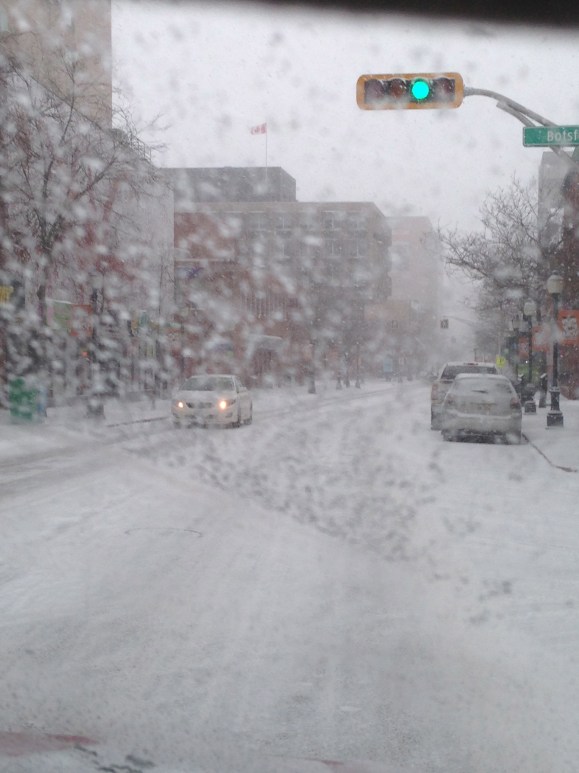
It sounded idyllic. And so, with visions of ice angels dancing in our heads, we hit the road from Moncton. Two days later, the news, courtesy of the CBC had this to say:

“People in Prince Edward Island are being asked by the province to stay home if possible today after a blizzard dumped a record 86.8 centimetres of snow at Charlottetown Airport on Sunday and Monday. The mainland was cut off from P.E.I. for more than a day and a half, as Confederation Bridge was closed at 4:50 p.m. Sunday and didn’t reopen until 7:20 a.m. Tuesday. General manager Michel LeChasseur told CBC News this may be the longest the bridge has been closed to all traffic since it opened in 1997.

Ahem. . .so much for my vaunted weather app. Still, I check it. I just can’t seem to help myself.

So it was the other day – whilst happily trolling through the long-range forecasts for Los Angeles; London, England; Halifax, Nova Scotia; and Guysborough County, Nova Scotia – I landed on Moncton.

There, I saw how gentle the temperatures would be in late February, how mild the predicted snowfall was. Then, I came upon a report for March 4: Thirty-five-to-forty-five centimetres of the white stuff with at least 15 more the following day. What?

I immediately phoned a tech-savvy friend and demanded an explanation.

“You know I actually have a job,” he began, alluding to the fact that he was at work and that I am a lowly freelancer who prefers to scribble in his “leisure suit” between bouts of weather-induced paranoia.

“Sure, sure,” I conceded, “but what do you make of this forecast? I mean, how can they know 14 days in advance what’s going to happen in my backyard?”

One word, he said: “Algorithms . . .The less snow that falls in any given winter, the more snow gets computer modelled and pushed to the end of the year. It’s math, boy, simple math.”

That, I protested, doesn’t make any sense. In fact, I declared, “It’s not fair.”

No, it’s not, he sighed. “Neither is the fact that you’re an idiot.”

I went back to my weather app and found that the forecast had changed again. It would be, after all, much milder and gentler. Crisis averted. Paranoia mitigated. All’s right with the world again. Thank you, weather app.

It’s funny how I never do this in the middle of summer.

Tagged , , ,

What’s in a word?

IMG-20120908-00198

It’s awfully nice work, if you can get it, though I suspect a facility with words – specifically, the ability to pull them from thin air – doesn’t hurt.

Meet Sir Michael Barber, once a high-ranking serf in the former British government of Tony Blair and now co-chair of something called the Centre for Public Impact (a creature of the Boston Consulting Group).

He’s been hanging around Prime Minister Justin Trudeau’s various offices of late, banging on about a little something he likes to call “deliverology”, which is, as near as anyone can tell, the art and science of getting things done in the civil service.

Actually, it’s a tad more complicated than this, as Sir Michael and co-authors Paul Kihn and Andy Moffit explained in their 2011 monograph, Deliverology: From idea to implantation.

“Now more than ever, governments are under pressure to deliver results in public services while ensuring that citizens’ tax dollars are spent wisely and effectively,” they write. “Nearly all governments – and individual public agencies – have set ambitious reform goals and developed strategic plans to achieve those goals. . .The challenge for public-sector organizations is to find ways to define and execute their highest-priority objectives so that they have the greatest possible impact.”

Enter deliverology, an approach the authors say “leverages and extends the key principles of best-in-class performance.” (In fact, they also say the word was originally crafted as “a light-hearted term of abuse” for the process adopted by the Prime Minister Blair’s Delivery Unit, and only later transformed into the expression it is today, replete with positive connotations).

Whatever its derivation, Prime Minister Trudeau and the Privy Council Office appears to be taking deliverology with deadly seriousness. News reports say that Deputy Secretary to Cabinet, Michael Mendelsohn, now runs the new Results and Delivery unit. According to Tony Dean, quoted by the Globe and Mail last week, “I suspect (he) will be talking to the Prime Minister and his senior staff about whether or not there are top-level, five or six, high-level priorities that the delivery unit will be initially rallying the system around.”

And why not? As silly as the word sounds, there’s some evidence that the management approach it represents actually works. Even the venerable, sometimes stodgy, Economist has given Sir Michael’s innovation a mild endorsement. “The lesson is that doggedness and consistency are of more use to the deliverologist than popularity,” a review last year of the former civil servant’s book on the subject reads. “(The) 57 rules for success range from the commonsensical – ‘Review the capacity of your system to deliver agreed goals’ – to the controversial – ‘Successful markets and effective government go together’, which has as many exceptions as proofs around the world. Yet this account of a potentially dry subject has an uplifting brio to it.”

All of which suggests, apart from anything else, that after years wandering the political wilderness in Canada, high-powered consultants have re-entered public life. Former Prime Minister Stephen Harper was famously intolerant of any advice, save his own, on how to run a government. Mr. Trudeau is a far more consultative sort. And it seems to be going around.

Last week, Brunswick News reported that one of New Brunswick Premier Brian Gallant’s friends and, until recently, a provincial Liberal Party operative, has been recently enlisted by TransCanada to lobby the feds on the Energy East file. According to the story, Justin Robichaud will “seek government support for the proposed project, including updates on. . .development and stakeholder consultation progress.”

Can we then expect a little more pipeline deliverology in the offing?

Tagged , , , ,

Yankee come home!

Oh to be a bluenoser now that the three-minute-long spring becomes us

Oh to be a bluenoser now that the three-minute-long spring becomes us

New Brunswick’s department of tourism (or whatever they’re calling it these days) should take a page from one Cape Breton radio personality’s playbook on luring wandering Yanks to these shores.

As Canadian Press playfully reported last week, “The creator of a cheeky website that encourages Americans to move to Cape Breton before Donald Trump can be elected president says he’s been shocked by the response. . .Traffic to the website has increased steadily, reaching over 35,000 unique visits on Wednesday (February 17).”

The spillover effect has also been pretty commanding. Said the CP story: “The site includes a link to Destination Cape Breton, which promotes tourism on the island. CEO Mary Tulle says U.S. traffic to her website over the past three days has jumped from almost 1,300 visits last year at this time to almost 12,000 this week.”

The man behind the fuss, Rob Calabrese, was, himself, gob smacked by the reaction. “I’m in disbelief,” he told the wire service. “I wish everyone from Cape Breton could read them (emails from Americans), because they really make you proud of living here. Some are writing about how it feels nice to know that they are welcome somewhere. A lot of Americans think that they’re not very popular in the eyes of the world.”

Heavens to betsy! Wherever did they get that idea?

Here, then, are a few collected quotes (courtesy of the CBC) of Mr. Trump from 2015:

“I don’t need anybody’s money. . .I’m using my own money, I’m not using the lobbyists, I’m not using donors, I don’t care. I’m really rich.”

“The U.S. has become a dumping ground for everybody else’s problems.”

“When Mexico sends its people they’re not sending their best. . .They’re sending people that have lots of problems. . .They are bringing drugs, they’re bringing crime, they’re rapists.”

“Obamacare really kicks in in 2016. Obama’s going to be out playing golf, he might even be on one of my courses. I would invite him. . .I have the best courses in the world.”

“I will be the greatest jobs president that God ever created. I will bring back our jobs from China, from Mexico, from Japan, from so many places. I’ll bring back our jobs and I’ll bring back our money.”

“I’m a free trader, but the problem is you need really talented people to negotiate for you. . .But we have people that are stupid.”

“I like China. . .I love China. . .Their leaders are much smarter than our leaders.”

Need we say more?  Or, as Heather from Missouri points out on the ‘Cape Breton if Donald Trump Wins’ website, “As an American who has spent time in Nova Scotia exploring new opportunities and the idyllic landscape over the last three years, I would highly recommend a visit Northeast – destination Cape Breton Island. Fair warning, though, you WILL be charmed and delighted. Political asylum seeker, curious traveler, or modern nomad seeking jaw-dropping beauty, rich culture, and inspiring collaboration value, oceanside? Pack your skill set, and explore island life beyond the confines of a tourist/visitor visa. Consider the NAFTA Skilled Workers Program as a path to legal residency for American immigrants.”

In fact, the website has received an enormous amount of publicity over the past few days, having received write-ups in mainstream print and online news organizations across North America, including The National Post, Winnipeg Free Press, Vancouver Sun, Fortune, and the Huffington Post.

All of which may only prove that Mr. Trump is the greatest gift God ever created for improving Atlantic Canada’s anaemic immigration record.

Tagged , , ,

Polling for the truth

DSC_0242

If you are New Brunswick Premier Brian Gallant, reading in a provincial newspaper that a recent poll indicates he’s no longer the flavor of the month among voters, you might be tempted to issue your own press release sardonically headlined, “alert the media”.

Except, oh yeah, they already know.

The relationship between the public, per se, and public opinion surveyors (and purveyors) is both close and ancient. It started sometime back in the 18th Century when a guy with a quill and piece of parchment stopped a passerby on a fetid London street and queried, “What ho, young man; what say you about the Jacobites? Aye or nay?”

Naturally, the results of such straw polls quickly traveled far beyond the coffee houses and gin dens and eventually made their way into the hands of the era’s pamphleteers who dutifully reported that, according to popular opinion, the king was a fool, the queen was a harlot and that even the most educated man couldn’t spell the word ‘Jacobite’, let alone venture an opinion on what it signified.

Thusly, dear reader, was born what we affectionately, if somewhat ruefully, refer to as popular democracy. As a member of the modern Fourth Estate who spends altogether too much time parsing opinion polls in the interest of hearing himself talk, I have. . .ahem. . .only one thing to say, a rare example of concision, if you will, amongst my ilk: You’re welcome.

Specifically, you are welcome to my conviction that public opinion polls are, for the most part, blunt instruments (with a margin error of plus or minus 100 per cent, 20 times out of 20) for digging at the truth about the electorate.

You are also welcome to my belief that the recent craze in this industry for providing online surveys to all and sundry (except, naturally, to those without high-speed Internet connections) only further blunts these instruments.

Still, let none of this dissuade the Angus Reid Institute from pursuing its appointed rounds. Its new survey indicates that 33 per cent of New Brunswickers approve of Brian Gallant’s performance in office. That’s a point lower than he scored in December, but a convincing improvement from his 25 per-cent showing in September. (Las Vegas odds makers must be salivating over their potential windfalls in April, when the latest provincial budget fully influences opinion).

According to a piece in the Saint John Telegraph-Journal, the premier’s performance numbers put him right in the middle of the pack of his provincial peers across Canada, which is a sort of glass-half-empty-glass-half-full result. After all, if a third of New Brunswickers like the man, then as much as two-thirds do not.

What, exactly, does that mean?

Former premier David Alward held onto power within the first few months of his mandate with less than 30 per cent of the popular vote; his approval ratings actually rose in the weeks before the provincial election that ended him.

Again, what does that mean?

In the Telegraph-Journal piece, reporter John Chilibeck issued the following caveat: “While Angus Reid says its results are based on a sample size that carries a margin of error of plus or minus 1.2 per cent, 19 times out of 20, the sample size in New Brunswick was the smallest, with only 301 people polled. . .The margin of error (here) would be plus or minus 5.6 per cent.”

Statistically, then, that would mean Mr. Gallant is either enjoying the best ride of any sophomore premier in the history of the province or the worst.

In either case, alert the media.

Tagged , ,

We don’t mean to be rude, but. . .

IMG_0656

We’re the best, the brightest, the fastest. We’re so exquisitely fine, the sun glints off even the ugliest girders in our fast-corroding downtown core, just as it does off the brand, spanking new strip malls along the ribbon roads and circumferential highways that encircle us.

Welcome, Canada, to the eighth-fastest growing ‘metropolis’ in the country, the purebred greyhound of the Atlantic region.

Say hello to Greater Moncton. . .again.

Sure, we’ve been here before – before your adoring eyes. You know we have. You’ve read about us in the headlines. We’re the little city that could. We’re the home of social and economic pugilists who famously (if sometimes nauseatingly) “punch above their weight class”. Does the phrase “resurgo” ring a bell? It should.

We’re one of the world’s “smart cities” (if only because we weren’t entirely too late to the global party of installing free public Wi-Fi in our downtown). We’re the nexus of economic dynamism in southeastern New Brunswick (whatever that means), of transportation, light manufacturing, university innovation, and information technology. We’re great, and we know it. We just don’t brag about it; that, after all, would be rude.

And we don’t want to be rude. Heaven forbid that we let our hubris run away with our modesty and bury it in a muddy flat of the Petitcodiac River, which, in case we failed to mention, now hosts one of the greatest displays of tidal-bore activity on the freaking planet. Did I say planet? I meant universe.

Of course, we don’t have to brag about our achievements here in the Hub City. We have Statistics Canada to do that for us. Except for Moncton, said the agency in a recent report, “Preliminary estimates indicate that the seven CMAs (Census Metropolitan Areas) with the highest population growth rates were all located in Western Canada. In 2014-15, the population growth rate was two per cent or higher in four CMAs: Kelowna (+3.1 per cent), Calgary (+2.4 per cent), Edmonton (+2.4 per cent) and Saskatoon (+ two per cent). They were followed by the CMAs of Regina (+1.9 per cent), Abbotsford–Mission (+1.4 per cent) and Winnipeg (+1.4 per cent).

“In contrast, the CMAs that posted population decreases were all located in Eastern or Central Canada. The population decreased in the CMAs of Greater Sudbury (-0.3 per cent), Saguenay (-0.2 per cent), Peterborough (-0.2 per cent) and Thunder Bay (-0.2 per cent).

Population growth also varied in areas outside of the CMAs. In 2014-15, the non-CMA part of Alberta grew at a rate of 0.7 per cent, the highest among the non-CMA areas for the provinces. Population decreases were recorded in the non-CMA parts of three provinces: Newfoundland and Labrador (-1.1 per cent), Nova Scotia (-0.7 per cent) and New Brunswick (-0.4 per cent).

Except, naturellement, good, old Moncton, which posted a population growth rate of 1.3 per cent over the past year and a bit.

We are obviously overjoyed to be counted in this company of speedy CMAs. We also mourn the loss of vigour amongst our closest civic neighbours (Saint John at -0.4 per cent? Oh, for shame!).

But I wonder what any of this actually means in the larger scheme?

New Brunswick’s population can’t compete with Mississauga’s. Noting that Moncton is a “fast-growing” community is akin to observing that a snapping turtle runs more quickly than a tortoise.

If this province hopes to reverse its economic and demographic fortunes, its major communities must work together to determine how we all become the best, the brightest and the fastest.

Tagged , ,

The countdown begins

FullSizeRender

A word to the wizened, if not always the wise: Only 35 shopping days remain before spring raises its lovely, garlanded head. Unless, of course, you count the weekends which, given the lack of money in various bank accounts around the region these days, why would you?

I like to pretend that in a little more than a calendric month, we in southeastern New Brunswick will be well on our way to a long, beatific summer. Of course, I like to imagine a lot of things that only rarely come true.

About this time last year, I was feeling pretty much the same way as I am today about the universe. In the first place, it looked like we had, for once, dodged the great, white bullet of winter. No more talk of polar vortexes, Alberta clippers and Nor’easters. Only sunny skies and gradually warming temperatures stretching ahead as far the mind’s eye could see.

We all know how that worked out. Two days before the official start of spring 2015, the Weather Network, with its irritating, trademarked cheerfulness, recapped the winter that was:

“According to unofficial totals as of March 18, this winter has now brought snowfall amounts that crack the Top 5 in Moncton, N.B., Saint John, N.B., and Charlottetown, P.E.I. As of Tuesday, March 17, Moncton was only 2 cm away from reaching the Top 5 with a snowfall total of 450 cm. As of 9:35 a.m. AT Wednesday morning, Moncton unofficially reported about 4 cm, which would put them in the no. 5 spot, knocking off the 1991-1922 winter.”

Still, what gives me hope that February and March of this year won’t, again, prove me a liar to myself is another Weather Network bulletin issued just last week. To wit: “The past two winters were dominated by a particularly resilient weather pattern, which kept the warm influence of the Pacific confined to the West Coast, and left the Eastern US open to persistent outbreaks of brutal Arctic cold. The winter of 2015-2016 finally looks to bring an end to this stubborn setup.”

Ah, yes. Good, old El Niño, the oceanic phenomenon that typically brings milder-than-average weather to the eastern seaboard, and chillier-than-seasonal temperatures to the southwest. The continent is experiencing an usually strong one this year. Or as the Weather Network reported a couple of months ago, “El Niño set a new record for heat in the central Pacific Ocean this week (November 24). Is it on track to become the strongest El Niño we’ve ever seen, and what could this mean for the winter?

“So far, El Niño 2015 has been very unusual. Teasing NOAA (National Oceanic and Atmospheric Administration) orecasters with signs and signals through 2014, it ultimately procrastinated in its actual development until early 2015 and it has been growing since, into a rival for some of the strongest El Niños we have on record. As of now, it has already set a new record, though. Weekly measurements of temperatures in the central Pacific ocean are now 5.4 degrees Fahrenheit above normal for the very first time in the quarter century that these measurements have been taken.”

On the other hand, as in all things weather related in this region, we hold our breath in abeyance of any certainty that our faith will be rewarded. For my part, I’ve lined up my seven shovels on the front veranda as if to challenge the first truly big blow to hit the city.

C’mon, I dare ya!

Tomorrow, it’ll be a mere 34 shopping days till spring. And I’m on a roll to blossom time.

Tagged , ,

How winter’s bone tests us

Permanent winter for a Moncton events centre?

We may remember the dreaded winter of 1992. Perhaps we choose to forget in the Hub City, which took the brunt of one of the worst white dumps in the recorded history of the province.

My sister was living here at that time and she remembers – so well, in fact, that she rarely sets foot in this fair town after the fall equinox and before the summer solstice.

The snow in 1992 reached the second-floor window of her apartment near Steadman Street. To escape, to get, say, milk and eggs, she crafted a makeshift bunny hill on which she slid to ground. (How she returned to her abode, I’m not entirely clear; something about climbers’ axes and pitons hovers into my long-fossilized mind).

The point is, as rough as we’ve had it recently in New Brunswick. . .well. . .it’s been rougher.

Nineteen-Ninety-Two was also the first full year of a brand, new tax introduced in a brand, new recession – the HST. As the snow continued to fall, joblessness in this province rose well above 15 per cent. Poverty and illiteracy rates were among the highest in the country. Violent crime was a daily occurrence in Moncton’s downtown core, which was, by the way, easily mistaken for certain boroughs of the burning, benighted southern reaches of London, England, where hooligans and punks roamed the streets nightly.

Last winter, one snowplow driver told Global News, “We’ve got as much snow now as we had then (in 1992). But then it came kinda all in like two or three days where this has taken a week. Then, we could not even drive with the truck with the wing down.”

All of which is to reiterate that notwithstanding last winter’s absurd “White Juan”, which seemed to last for weeks (trust me, it did; I have the pictures to prove it to my Los Angeles-based, Venice-Beach hovering, muscle-bound brother), we’ve actually had it pretty good in Moncton over the past two decades.

We’ve rebuilt our local and surrounding economies. We’ve diversified away from solitary, single industries and into integrated, diverse ones. We’ve embraced the notion of cultural and linguistic duality so completely that we’ve managed to host a baker’s dozen of major, international francophone events without materially or socially threatening anyone in this community who can’t (or doesn’t) speak and read the French language.

We have become, in effect, what we intended to become: a cosmopolitan city that welcomes newcomers with a shake of the hand and a slap on the back; an urban centre of 140,000 people that, on a good day, habitually behaves as if its region is ten times larger, as if its heart is 20 times as big, as its census data routinely reports.

We may one day remember the dreaded winters of 1992, 2015 or, indeed, the one we’re in.

In the meantime, the HST will surely rise. Toll fees will surely smack travellers on provincial highways. Income taxes might rise.

But all of this won’t stop us from inventing better tools for digging out from under an avalanche of debt and deficit. We are, in the end, remorselessly resourceful; we will outlast this particular winter.

And if we do eventually touch that rim at the edge of the world – on a hot summer day when the clouds gather over the ocean, and the sun shines through and onto New Brunswick – it will be ours to grab.

We will have sacrificed the memories of bad times to erect those of good ones, when winter’s bone does not so easily test us.

Tagged

The walking cure

IMG_1563

I rise from my perch, where I scribble, throw on a parka from the back closet, grab my keys, wallet and phone, and struggle to lock the door behind me. I face the wind, look both ways before I cross the threshold of the front porch and then I begin. I am going for a walk.

I do this every day, but I do not do it lightly. At a specific time, usually mid-morning, the sun squeaks through the blinds of my downtown Moncton home as if to remind me that my feet must move, my legs must stretch, my lungs must breathe. Take, it says, the walking cure.

The cure to what, you may ask? Well, whaddya got?

The fact that more Canadians live in poverty than at any time since the Great Depression of the last century; there’s that. The realization that big corporations in this country are literally flowing with retained earnings, yet penny-pinching their employees to the blood-blister point; there’s that too.

But, no, the real spiritual malaise in all of us stems from a desperate certainty that we have become pawns on the chess board of global politics; that the right hand of power meets the left, daily and dutifully, in the assemblies and parliaments we once assumed were ours to direct, as citizens of elected democracies, from the muddy, munificent middle.

No more, no more. I’m walking.

I trudge through the streets of the old West End of Moncton, admiring the modest homes that a socially democratic nation made possible 60 years ago. I pause, occasionally, to stare at the mansions that absurd wealth and privilege have purchased only recently.

Should we be that rich? Should we be that poor? How shall we all live together, living, as we do, in such close quarters?

I march down Gordon Street, which inexplicably becomes Queen Street, past the halfway houses and empty lots, past the real estate companies and condo developments, past the placards that taggers have signed, “What do you have to hide?”, past the agents’ billboards that declare there are dreamy properties in the offing if only you will offer, perhaps, your first-born cheque on a dare of belief in the future of a province that can’t seem to balance its books, care for its invalids, and educate its precious young.

No more, no more. I’m walking.

I walk the way a man stumbles into the woods: with one knee pounded into the ground and one hand splayed angrily against the sky.

As the late, great polemicist Henry David Thoreau wrote in the 1900s, “We should go forth on the shortest walk, perchance, in the spirit of undying adventure, never to return; prepared to send back our embalmed hearts only, as relics to our desolate kingdoms. If you are ready to leave father and mother, and brother and sister, and wife and child and friends, and never see them again; if you have paid your debts, and made your will, and settled all your affairs, and are a free man; then you are ready for a walk.”

Are we, then, men and women in Canada, in New Brunswick, prepared to ask, challenge and agitate – in effect, to rise from our various perches for a gritty stroll that risks changing our attitudes, our very minds about what we can achieve?

How many of us are actually willing to go for a truly meaningful walk in this country, in this province, in this city, in this time of our lives – to cross the threshold and, in the wind, begin again?

Tagged

The hitchhiker’s guide to marriage

When, from time to time, people of my acquaintance ask me how we’ve managed to do it – that is, to stay together for three-and-a-half decades without observable scars, psychic injuries, or durable mental anguish, I invariably answer in one, or both, of two ways:

“A sense of humour helps. . .So does a truly bad memory.”

Today, my wife and I celebrate our 35th anniversary of wedded bliss; twenty years of this span, we’ve spent in Moncton. And, as a recipe for marriage nothing beats the time-tested strategy of bad jokes and selective amnesia.

“Do you remember when we first arrived here?” I asked her just the other day in the midst of a binge-viewing session of the Star Wars franchise. (We had reserved seating for the newest one, you see, so boning up on the mythology was Job # 1).

“I remember that you never could shut up while we were watching our favorite shows,” she barbed.

“Hah! That’s a good one, my dear.”

“Yeah, here’s a better one: Why don’t you shovel the walk like you said you would before it freezes over?”

That’s an even better one, I thought. (As if I would ever perform a household chore before it became utterly intractable.) Of course, that’s one reason why I love her so: She’s a truly funny lady.

I am, on the other hand, a truly forgetful man.

I remember my daughters’ birthdays and, lately, those of my grandkids. But ask me what date my own occurs, and I’m likely to mumble something about November, towards the end of the month. (In fact, I rely on Facebook to tell me these things).

On the other hand, I rarely remember what I ate last night, what show I watched, what book I read, or which newscast threw me into an apoplectic fit of self-righteous indignation.

Did I walk four miles or merely three today? Did I work out on the floor mat for 30 or 45 minutes today? Do my pants make me look fat?

“Yes, actually. . .your pants make you look fat,” my beloved confirms. “But that’s only because you buy them from the little-boy section of Gap.”

Funny stuff. She should go on the road, she’s so fine; get herself a Netflix stand-up gig. I would be her manager, parsing out bottles of water and running interference between her and her legion of fans. I would give up everything to see her tell the big, wide world exactly what’s on her superb, incisive mind.

Of course, these are the moments of which I have perfect recall: The look on her face when she laughed in the summer of 1977, having seen a wild lily in a broken ditch along Hollis Street in Halifax; the way the setting sun steamed the waves at Crystal Crescent Beach on the South Shore of Nova Scotia as she searched in vain for her missing hiking boot in the winter of 1978; the old, grumbling roar of the rollers crashing onto the shore of Chedebucto Bay as we walked silently to the tip of Ragged Head and then back again in the fall of 1984.

How do you stay together for 35 years? It’s a good question. No pat answer serves. A sense of humour is crucial, yes; so is a convenient memory. Most of all, though, the recipe involves a daily dose of imagination, empathy and forgiveness.

And isn’t that that the reason for any of us to get up each morning?

Aren’t we all hitchhikers on the road to love?

Are the kids actually all right?

Whence the minions came to me, seeking my munificence as laird of Bruce manor, I said unto them: “Daughters, kneel close, for I shall not sayest unto thee again.”

And so they did.

“Uh, Dad,” one queried, “What do you want?”

The other one, loaded with homework, merely uttered, “I don’t have time for this. . .Can you write me a letter, or something?”

I bellowed, as befits the King of the Castle, Nay! “Now here’s the deal: I command you both to become print journalists. In this way, you will carry on a valiant tradition – now three generations in the making – of making no money, subjecting yourself to the whims of editorial style, and becoming a self-loathing supplicant of various chain-store media flavors. Oh, and by the way, you should go to college poste haste, rack up enormous debt to prepare yourself for the life of which I speak, and spend the rest of your productive careers looking for good gigs interviewing rappers and garden ladies on CBC. Sound like a plan?”

Oddly enough, my minions don’t remember any of this – most likely because none of this actually happened, except, perhaps in my own feverish brain on a night when I had hoped that I would be heard, considered and then, finally, dismissed as any kind of example.

Indeed, if you read a recent RBC report you discover that “parents underestimate the influence they have over their children’s education. . . While 28 per cent of students say they chose the program they’re in to please their parents, only 21 per cent of parents think they have this influence. What’s more, when it came to deciding whether or not to go to post-secondary school, 10 per cent of students made this decision to satisfy their parents, but half as many parents felt the same.”

I’m reasonably certain that when I decided to go to Dalhousie University and study geology, physics and math in the late 1970s, it was not to please my artistically inclined, journalistically bent parents who – upon hearing my freshman-year course selections – could barely contain their mirth. As it happened, within a year, I had joined them in the general, family giggle.

Yet, I do remember my father and mother encouraging me to follow my dream, whatever it was, in my young life.

I also remember telling my own kids to do the same. One is now an analyst in early childhood education. One is a practicing veterinarian.

Says Mandy Mail, director of Student Banking at RBC Royal Bank: “From choosing which school to attend to selecting a program, students are making decisions to please their parents. It’s important for parents to maintain an open line of communication to ensure students are being thoughtful with their approach and to help ease the stress and encourage a more optimistic outlook on their future.”

Well, Mandy, with all due respect, that just sounds like another speech from another throne situated on a podium to which both students and their parents come to worship, hoping to score the bucks necessary to fill the banking industry’s notion of mortgage-worthy success.

Here, young ones, have another interest-free credit card. Do your university courses dovetail with our actuarial tables predicting income success? If so, have another credit card. Have three.

Come minions; come to us. We’re not your mum or dad. Worship at the feet of the real King of the Castle, mammon.

Unlike your parents, who love you unconditionally and support just about any direction you choose, we’re simply waiting at the crossroads.

Tagged ,