Category Archives: Humour

An open letter to Brian Gallant, the new leader of Eastern Canada’s la-la land (AKA New Brunswick)

Surf, baby, surf!

Surf, baby, surf!

Dear Mr. Premier,

Allow me to congratulate you on your recent victory at the polls, you poor bastard.

Why anyone would subject himself to the slings and arrows of the New Brunswick electorate, only your political forebears and God Almighty knows.

But here you are, taking names and numbers, dropping the small-business tax rate by 50 basis points on your first day in office, promising a $900-million-dollar infrastructure build over six years (two years longer than your current mandate), and vowing to steer this ship of state around the shoals and sandbars that have sunk previous governments, both Grit and Tory, for nearly a generation.

Good for you.

Here’s the excellent news: You are young, educated, smart, and perfectly bilingual.

Here’s the less excellent news: You are young, educated, smart, and perfectly bilingual. Naturally, people will expect you to hand them the world on personalized pewter platters.

A few things going in your favour include a radically curtailed cabinet, the semblance of a ‘right-sized’ public bureaucracy, and cuts in everything except front-line services in health care and social programs. There’s also your avowed commitment to educational attainment in New Brunswick, an ambition that, heretofore, has continued to disappoint educators in this province. All of which should leave the impression in the minds of all but the most vested interests and partisan individuals that you are serious about the commonweal.     

The many things going against you include a $400-million deficit and $12-billion debt that, for all the world, looks like a permanent feature of the fiscal landscape; a moribund economy (apart from some recent, positive signs from the mining and forestry sectors) that’s still far too reliant on seasonal and part-time positions in rural areas; a mismatch between highly skilled jobs and training in urban areas; and a steady flow of talent (what economists like to call ‘human capital’) to points west, notably Alberta.

Then, of course, there are the lobbyists.

There is, for example, the Coalition for Seniors and Nursing Home Residents Rights, whose executive director Cecile Cassista told the CBC this week, “Right now, we have about 57 agencies and basically getting money from the government, which really doesn’t actually meet the needs of the workers that are doing the work.”

There’s the Canadian Federation of Independent Business, whose director of provincial affairs Denis Robichaud also told the CBC, “We see positive measures, I think, in the Liberal program on (taxation). . .But the new Liberal government also plans to return business property tax rates to the levels in place in 2012 so that worries some of our members also.”

And this doesn’t begin to scratch the surface.

Still, you correctly assess the dimension of your challenge when you say, as you did recently in an interview with the Telegraph-Journal, “The whole point of why I embarked on this adventure was to try to make a difference. Now, I really do feel I have the capability and the responsibility to make a difference. . .We have some rocky roads ahead of us as a province to get over these challenges. But we will take it very seriously, and we will make the right decisions so we can get over that hump and make sure we have better says as a province.”

Mr. Premier, I will leave you with two thoughts.

The first is: be bold right away. Make all your dramatic, radical moves within your first year. Your job is no longer to win friends and influence people. That one terminated on election day. Your job is to slay the beast and save the girl (metaphorically speaking about New Brunswick as a damsel in distress may not, however, serve your interests as you are the province’s minister responsible for women’s equality).

That brings me to my second point: keep your sense of humour. You’re going to need it. Remember what Groucho Marx once said (“Politics is the art of looking for trouble, finding it everywhere, diagnosing it incorrectly, and applying the wrong remedies”), or Ambrose Bierce (“a vote. . .is the instrument and symbol of a freeman’s power to make a fool of himself and a wreck of his country”)

Good luck, you poor bastard.

Tagged

Muskrat love and Mountie wardrobe malfunctions

DSC_0026

It’s always heartening to see Canada’s elected officials prosecute the course of our democracy with assiduous attention to detail. And what could be more minutely meaningful to the future of our rights and freedoms than the sartorial decisions of our national police force?

New York’s Fashion Week has come and gone, so we’re on our own with this one. Well, not entirely. Fortunately, there is Environment Minister Leona Aglukkaq, whom we can always trust to weigh in on the weightier matters of national security.

Commenting in the House of Commons last week about the RCMP’s policy change regarding the hats they issue to constables – that, henceforth, the traditional muskrat-fur toppers will be replaced with woolen toques to all but the most northerly, frostily bound units – the minister said, in effect, ‘no way.’

I wish I could get behind her.

After all, don’t fur trappers account for 95 per cent of the working population not already productively engaged making Leonardo DiCaprio’s life a living hell at Alberta’s tar sands?

And, considering that the trade in animal skins accounts for several gagillion dollars worth of national gross domestic product today (or was that in 1680?) doesn’t she make a point, and, perhaps, isn’t that all we can expect from our political leaders in these the last days of common sense and pragmatic wonder in 2014?

Still, I truly ponder the effects her declaration that the “RCMP decision, which is causing much glee among anti-fur activists, is being overturned” will produce among the voting public. Recent signs are not particularly auspicious for the reigning Tories.

As a recent EKOS Research public opinion poll makes clear, Harpertown has lost much of its mojo among average Canadians. “On a range of issues – law enforcement, legalization of marijuana, foreign policy, and the appropriate role and size of government – a majority of Canadians are offside with the government, the survey suggests,” Mark Kennedy writes in the Ottawa Citizen.

“The electorate is becoming rapidly polarized with a wave of Canadians declaring their political ideology to be ‘small-l liberal,’ regardless of which political party they support . . . Moreover, the poll finds deep discontent among Canadians in key areas: Middle-class anxiety about the economy, a gloomy prediction about the quality of life for the next generation, a dissatisfaction with the ‘direction’ of the government, and a growing distrust of the political system.”

According to EKOS president Frank Graves, “When you have a shrinking, pessimistic middle class, that could become a crisis if left untended.”

Spoken like a true pollster; from the mouth of a babe who loves his numbers. Courtesy of the Citizen, which tabulated the EKOS findings, to wit:

Twenty-four per cent of people surveyed in 2008 considered themselves left of centre. Today, the answer is: 47 per cent.

Sixty per cent in 2008 said police should be able to shove around the innocent if that meant snagging a better chance to protect the body politic. Today, the answer is 29 per cent.

Meanwhile, says the Citizen article, 40 per cent of people polled say “international development and aid should be the utmost in Canada’s foreign policy” . . . 64 per cent surmise that the “incentive systems” in the economy are “broken and hard work is no longer paying off” . . . 57 per cent believe that “the next generation in 25 years will be ‘worse off’ in terms of quality of life” . . . and 56 per cent “support compulsory voting in Canada,” presumably as the best possible method to stave off another long period of political malaise and hat malfunctions at the RCMP.

As to those garments that cops should wear on their heads, this government remains defiantly unapologetic. Apparently, no branch of federal authority has the right to choose how it micro-manages its employees – not federal scientists, not publicly supported museums and parks, and certainly not the Mounties.

The latter had better get with the program, it seems, and slap those muskrat hats on their beans and without complaint. If they’re lucky, their authoritarian masters in government will follow suit.

Or, perhaps, they’ll use them to cover their arses in the long, hard, cold political winter ahead.

Tagged ,

Pearls of wisdom from the Buddha of showmen

DSC_0027

A casual acquaintance of mine (I’ll call him Cal Tripken), who makes a good living on the motivational speaking circuit in Toronto, sits across the table from me, picking calamari out of his teeth with a dessert fork.

“Sorry, dude,” he says. “I still don’t see what your problem is.”

Lunch is over and the cheque has arrived. I have a column to write, but I reckon I still have enough time to reiterate my predicament once more.

I have been asked to give a keynote address at business convention, I explain. I can say anything I want as long as it’s not scatological, pornographic or racist. My problem is that, in recent years, I have developed a morbid fear of public speaking.

Oh sure, I can write a screed for my city’s daily newspaper or for CBC radio that would, and often does, make a politician’s blood churn cold with rage, or an anti-shale gas activist’s dander jump like fleas from his overheated scalp. It doesn’t bother me at all; I sleep great.

But when faced with the prospect of speaking before a live audience of more than 20 people, my throat constricts, my palms sweat, and I cast a frantic glance over at the baby barn at the back of my garden and seriously wonder whether, with a few last-minute renovations, it might serve me well as a hermitage, where I might hole up for the rest of my life.

The curious thing about all of this is that when I was much younger, I was a professional stage actor who had no trouble – indeed, I relished – holding the attention of a theatre packed with between 500 and 1,000 patrons at a time.

So, I ask Cal, what gives. . .dude?

“Well,” he says, putting down the fork, “Let’s parse this. . .You are chiefly a political commentator. . .Correct?”

Correct.

“So, that means that you presumably know something about the subjects that interest you. . .Right?”

Right.

“Bro, there you have it. That’s the problem in a nutshell.”

He still has a little strand of squid stuck between his lateral incisor and canine teeth, which I decide to ignore.

“What are you talking about?” I say as I check my watch and hand my credit card to the sever, as her several, earlier attempts with Tripken’s plastic produced inconclusive results.

“It’s as clear as the frog in your throat. . .You’re too authentic. Your audience doesn’t want to hear what you really think. They want to hear what they think, in your voice. That lets them off them off the hook from actually having to think for themselves.”

Dear Buddha, do go on.

“Deep down, you know this; you’re just not admitting it to yourself. You can write a speech in the privacy of your own boudoir and rehearse it until the cows come home. But if it actually comes from you, what is really you, it’s always going to sound hollow to you when you’re giving it in front of a live audience. . .Frankly, my friend, you’ve forgotten your theatre training. Nowadays, it’s all about the show, baby.”

So, I venture, maybe I should put a pillow under my jacket and prance around the stage like an ersatz Richard III sounding fury and melancholia during speech. Or, perhaps, I should channel Marlon Brando in A Streetcar Named Desire and scream “Stella!” at the top of my lungs before I segue into a dissertation about how a higher HST rate in New Brunswick will pay for. . .well, streetcars.

“Whatever, dude,” Cal says as he grabs a toothpick. “How do you think Ronald Reagan became the most beloved President of the United States in 50 years. It wasn’t because he was a policy genius. It was because he was an actor. . .And what about our very own Stephen Harper? Do you actually think that hard-talking Steverino means half the things he says. The guy plays soft rock on the piano. . .And in a sweater-vest, no less.

Tripken gets up to leave. “Now, I really gotta go and brush my teeth.”

I smile and, as I retrieve my credit card, say: “Oddly enough, so do I.”

Tagged , ,

The incredible shrinking man mourns our dietary obsessions

Big and bigger cavemen rejoice

Big and bigger cavemen rejoice

If I were a caveman, living 30,000 years ago, I would, in all likelihood, resemble Arnold Schwarzenegger in the 1970s and not Woody Allen in the 1970s. That’s because my caveman antecedent (and Arnold) ate meat, eggs, nuts, fruit and that’s about it; whereas Woody and I ate bagels.

I can’t speak for one of my favorite (if diminutive) filmmakers, but Elizabeth Kolbert can. She’s a staffer at the New Yorker magazine. She’s also a former Fulbright scholar and, recently, the author of “The Sixth Extinction: An Unnatural History”.

So, I assume she knows what she’s talking about when she pronounces, as she does in a recent issue of her esteemed organ, “According to a study of human remains from China and Japan, the height of the average person declined by more than three inches during the millennia in which rice cultivation intensified. According to another study, of bones from Mesoamerica, women’s heights dropped by three inches and men’s by two inches as farming spread.”

Indeed, she writes, “A recent survey of more than twenty studies on this subject, published in the journal Economics and Human Biology, found that the adoption of agriculture ‘was observed to decrease stature in populations from across the entire globe,’ including in Europe, the Middle East, Asia, and South America.”

And that’s not all: “Early farmers were not just shorter than hunter-gatherers; they were also more sickly. They had worse teeth – one analysis from the Near East suggests that the incidence of cavities jumped sixfold as people started relying on grain – and they suffered from increased rates of anemia and infectious disease. Many now familiar infections – measles, for instance – require high population densities to persist; thus, it wasn’t until people established towns and cities that such ‘crowd epidemic diseases’ could flourish. And, by living in close proximity to their equally crowded farm animals, early agriculturalists helped to bring into being a whole set of diseases that jumped from livestock to people.”

In fact, according to Ms. Kolbert and her expert authorities, it took thousands of years for humankind to recover its physical stature following the so-called Agricultural Revolution of the Neolithic Age.

To be clear, it took me only 27 months to get to a fighting, palaeolithic, trim weight of 150 pounds (waist size of 30 inches), from a relatively corpulent 180 pounds (waist size of. . .well, let’s just say, capable of eclipsing my view of my shoe tips). I did it by obsessively exercising daily and adjusting my diet and portion sizes.

As a result, my blood pressure is delightfully low (when, not too long ago, it was alarmingly high), my cholesterol is standing where it did when I was a callow youth of 17. I have more energy and enthusiasm for everything (which is fortunate, given that my beautiful daughters and their husbands have, in the past five years, given me four grandchildren).

I still stand only five-foot-nine and a bit on a good day (nothing I can do about that – thanks Agricultural Revolution!). But, generally, I feel pretty good for a man who’s about to matriculate into his 54th year.

But here’s the thing: The so-called paleo-diet fad has conquered the affluent corner of the western world, and to almost fascistic effect.

As Ms. Kolbert writes: “In promoting red meat and rejecting grains, the paleo diet challenges just about every precept that nutritionists have been pushing for the past fifty years. In effect, it turns the familiar food pyramid on its point. This is an increasingly common inversion, if not in academic circles or at the U.S. Department of Agriculture then on the talk-show circuit. In his wildly popular manifesto-cum-recipe book, ‘Grain Brain,’ David Perlmutter, a Naples, Florida, neurologist, maintains that sandwiches are not just hard on the digestive system; they wreak havoc on the mind. ‘Modern grains are silently destroying your brain,’ he writes. ‘Basically, I am calling what is arguably our most beloved dietary staple a terrorist group.’”

Is he joking? Does Woody Allen know about this?

Chill out, doc. The chances are that your inner caveman will appreciate the odd P-P-J on Wonder Bread, if only to prove that the species is just a tad more digestively adaptable than a young Arnold would allow.

Tagged , ,

The official flora of Canada’s next province: palm trees


DSC_0040

I get that John Baird is a very important man with a very important job doing very important things, like saving the world for Stephen Harper’s democracy. But does Canada’s foreign minister have to be such a party pooper?

Specifically, as the thermometer outside my office door barely nudged 10 degrees Celcius this week did he have to throw water on the idea of this country welcoming the tropical paradise known as the Turks and Caicos Islands into its provincial fold?

“We’re not in the business of annexing islands in the Caribbean to be part of Canada, so that’s not something that we’re exploring,” Baird declared on Monday, as the premier of the Caribbean state, a British protectorate, openly flirted with the notion of he and his 29,000 fellow islanders formally becoming Canucks. 

“I’m not closing the door completely,” Rufus Ewing told reporters in Ottawa. “It is not of my mandate to close the door. What I’ll say is on the radar is some kind of relationship. I can’t say what kind of relationship it will be,” 

Still, insisted Baird: “We’re not looking at any sort of formal association with the islands.”

But, as the Globe and Mail’s editorial writer asked reasonably yesterday, “Why the heck not? Yes, the idea is slightly loopy. But a people subjected to six months a year of winter, preceded by four months of fall, are entitled to the occasional tropical daydream. And if Newfoundland could go from a British colony to Canadian province, why not some slightly more temperate islands?.”

Of course, the circumstances of Newfoundland’s entry into Confederation in 1949 were unique to that place and time (having had something to do with 15 years of government by appointment only), yet Canada’s self-styled national newspaper is not wrong about this. And its readers concur. After all, if Richard Branson gets to own a palmy getaway at the equator, why can’t we?

“Has anyone even run the numbers?” writes Peter Sutherland of Ottawa. “The cost of providing Canadian social services for some 30,000 islanders versus the money that would stay in ‘Canada’ (not the southern United States or Mexico) during the winter? Looks like this rare opportunity will once again fade as fast as my short-lived summer tan.”

Adds Mary Lazier-Corbett of Picton, Ontario: “Assuming there is an informed wish on the part of Turks and Caicos to become part of our Confederation, it would have huge advantages to Canada. . .It would. . .open up opportunities for citizens in the ‘new‘ area and force us all to rethink, rationally, what it means to be Canadian. . .Go for it!”

Finally, this word from Janice Campbell of Halifax: “Frostbitten hand to winter-numbed heart, there is so much I’d forgive the Conservatives if they did this. Puh-leeze, Mr. Baird.”

Well, Mr. Baird, the people have spoken; what say you now? Shall you stand in the corner just as the festivities kick into high gear?

“If you don’t want another prov/territory,” Saskatchewan Premier Brad Wall tweeted to the prime minister, “Turks/Caicos can join Canada as a part of Sask.”

To which Prince Edward Island Premier Robert Ghiz responded, “Hey, Brad, PEI would be happy to partner with Saskatchewan on the Turks and Caicos project!”

Replied Wall: “Now we’re talking.”

Even Mr. Baird’s colleague Conservative MP Peter Goldring likes the idea. “There are opportunities that are going to be growing in the Caribbean,” he told Global News. “I think it would be good for business if we were to develop a good strong relationship and maybe even a marriage.”

It’ll never happen, of course, because the politicos in positions of real power – never the most imaginative among us – can’t divine an immediate up side.

I, on the other hand, can think of 12. In the Turks and Caicos, average high temperatures for January, February, March, April, May, June, July, August, September, October, November, and December are, respectively: 27, 27, 28, 28, 29, 30, 31, 31, 31, 30, 29, and 28 degrees Celcius. Plus, it never gets below 20 at night.

As one gets older, these considerations acquire greater significance, especially as one obsessively checks the mercury outside my office door. 

It’s May 28 and what do you know? The temperature just shot up to 13.

Maybe John Baird is right after all. 

Turks and Caicos? 

Bah, who needs you?


Tagged ,

The secret of our success is simple. We’re crazy


DSC_0028

Each day that passes on this third rock from an average star in the boondocks of a commonplace galaxy brings fresh evidence of the truth about our circumstances as, very likely, the only sentient creatures in this region of the universe.

Homo sapiens sapiens (us) are certifiably nuts. This, we already know. But that our derangement may very well derive directly from our intelligence is a proposition no evolutionary biologist would ever entertain. Until now.

In a marvelous review – still more marvelously titled “Consume, screw, kill” – of environment writer Elizabeth Kolbert’s new book, The Sixth Extinction: An Unnatural History, Harper’s writer Daniel Smith explains Swedish geneticist Svante Paabo’s determination to locate and identify the “madness gene” that makes us unique among hominins (all humans, including the extinct ones).

Mr. Smith quotes a passage from Ms. Kolbert’s work, directly:

“Archaic human like Homo erectus ‘spread like many other mammals in the Old World,’ Paabo told me. ‘They never came to Madagascar, never to Australia. Neither did Neanderthals. It’s only the fully modern humans who start this thing of venturing out on the ocean where you don’t see land. Part of that is technology, of course; you have to have ships to do it. But there is also, I like to think, some madness there. You know?’”

Indeed, who does that? Go off into the wild, blue yonder without an exit strategy? Apparently, we do. And not just that.

Writes Smith about The Sixth Extinction (for which, you may have guessed, our lunatic species is solely responsible), “Kolbert begins coyly with a kind of fairy tale. ‘Maybe two hundred thousand years ago,’ a new species emerges on Earth. Compared with other species around at the time – mammoths, mastodons, armadillos the size of Smart cars  – the members of this new species aren’t very fast or very strong. But they are shrewd or reckless or both. ‘None of the usual constraints of habitat or geography seem to check them.’”

What do they do when they finally reach what we now know as Europe? Writes Kolbert: “They encounter creatures very much like themselves (Neanderthals), but stockier and probably brawnier, who have been living in the continent far longer. They interbreed with these creatures and, by one means or another, kill them off.”

How, then, do our tendencies, singular among all animals, to wander like zombies into unfamiliar and treacherous territories only to plunder the local wildlife (and nightlife) before moving along relate to our possessing uniquely big brains?

Consider the results of separate research conducted in Israel. Scientists at the Hebrew University of Jerusalem compared the DNA of ancient Neanderthals with that of modern humans and found them to be about 99 per cent identical, which is what they expected. But when they examined the evidence more closely, they discovered significant differences in the remaining one per cent – specifically, between those parts of the archaic and contemporary genomes that were linked to disease, especially mental disease. Suffice to say, we modern types fared rather poorly. 

“Scientists are a long way from being able to understand what this means, stressed Liran Carmel, who led the study along with Eran Meshorer and David Gokhman,” Torstar reported the other day. ‘But this raises the hypothesis that perhaps many genes in our brain have changed recently, specifically in our lineage, the lineage leading to Homo sapiens. And perhaps things like autism, schizophrenia and Alzheimer’s are side-effects of these very recent changes,’ said Carmel. ‘This is an interesting suggestion, that (brain disease) is a side-effect of us being Homo sapiens and having our unique cognitive capabilities.’”

“Interesting suggestion” doesn’t even begin to cover it. 

For the first time in our lousy, rotten history, we may be at the threshold of obtaining true self-knowledge. 

Forget Socrates, Plato, Aristotle, Confucius. Keep your Enlightenment thinkers to yourself. And if you think religion is going to get you out of this one, think again.

The fix was always in; the game was rigged from the get-go. To paraphrase from a tune popular during the self-obsessed “Me Decade” of the ‘70s, we’re just no good, no good, no good. . .baby, we’re no good!

Of course, this also raises a rather unsettling corollary. If cognitive capacity actually produces mental disease, does the search for extra-terrestrial intelligence amount to nothing more than a bed count at a cosmic loony bin?

Then again, at least we’ll know we’re not alone in our insanity.


Tagged , , ,

Seated or upright: It’s a standoff


IMG_0779

Don’t say I never heed the warnings about my imminent doom, physical, spiritual, moral or otherwise.

Why, just the other day, having begun to peruse a lengthy report on the dangers of sitting around all day, I did something about my habit of rump perching. I raised my legs to roughly waist height, crossed my ankles, placed my feet on the desk, leaned back in my chair, and continued to read.

This from Dr. James Levine of The Mayo Clinic:

“Researchers have linked sitting for long periods of time with a number of health concerns, including obesity and metabolic syndrome a cluster of conditions that includes increased blood pressure, high blood sugar, excess body fat around the waist and abnormal cholesterol levels. Too much sitting also seems to increase the risk of death from cardiovascular disease and cancer.”

Indeed, the good doctor reports, “One recent study compared adults who spent less than two hours a day in front of the TV or other screen-based entertainment with those who logged more than four hours a day of recreational screen time. Those with greater screen time had: A nearly 50 per cent increased risk of death from any cause; (and) about a 125 per cent increased risk of events associated with cardiovascular disease, such as chest pain (angina) or heart attack.”

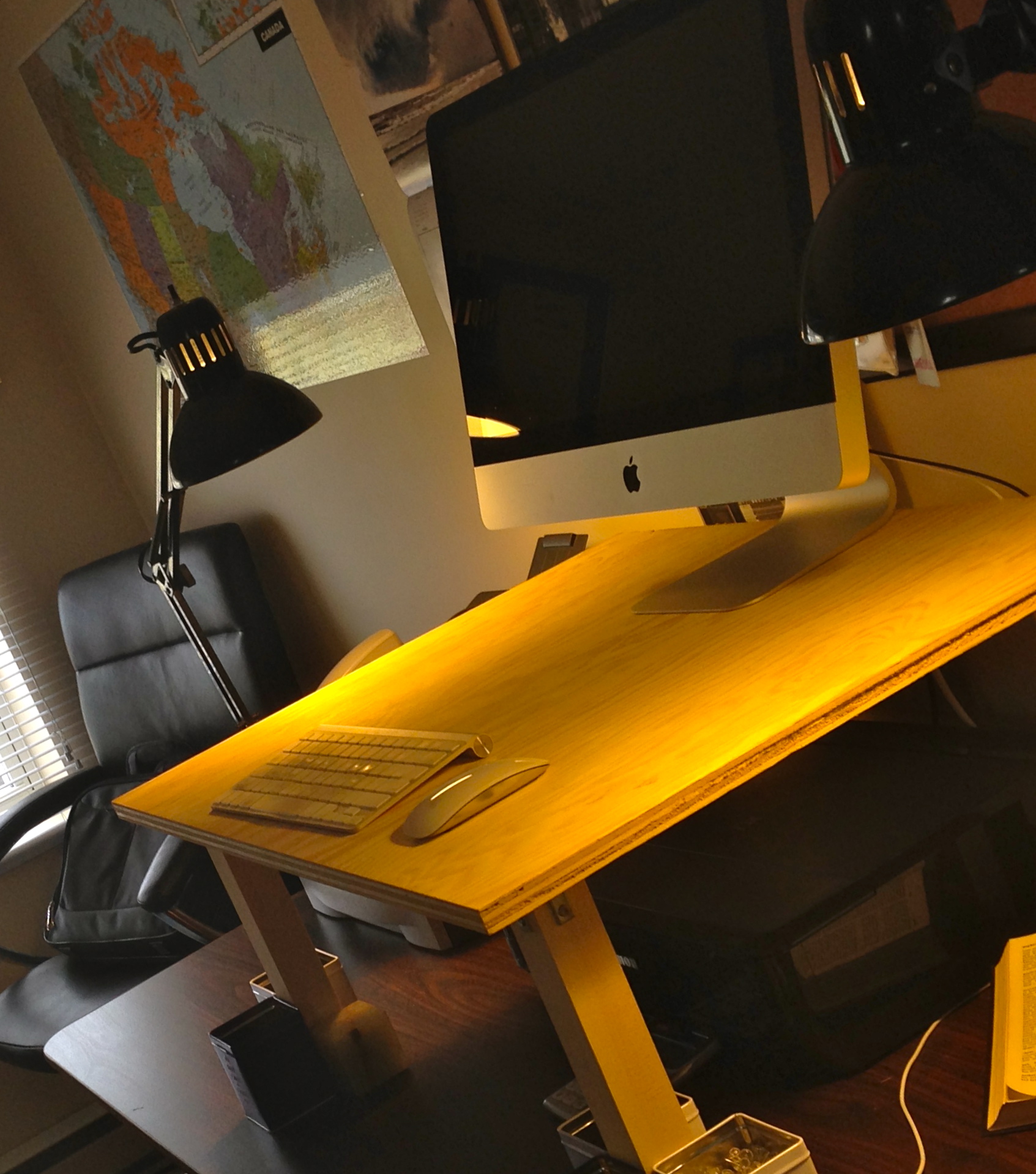
Well, then, the solution seemed obvious: Install a standing desk. These days, they’re everywhere. A simple google search pulled up Workrite’s Sierra HX-Electric Height Adjustable Stand Up Desk for a princely $1,479.00. There’s also National Business Furniture’s Standing Height Workstation for a more cost-effective $659. 

I had a better idea. I jumped to my feet and into the car. At my local Kent Building Supplies store, I procured a three-foot-square sheet of plywood (good one side), four 12-inch long pieces of 2×2-inch pine, 16 l-brackets, and a bunch of screws.

Once home, I assembled my custom-designed platform – expansive enough to accommodate my IMac, keyboard and mouse, with room to spare – and placed it atop the banquet table that subs for my desk. It was perfect. And cheap ($49.95).

Feeling enormously pleased with myself, I commenced to work from the standing position like some clerk in a Dickensian counting house. 

Naturally, my reverie was short-lived.

“Sitting at your desk all day is killing you whether or not you exercise, which is why so many people are building standing desks,” confirmed Adam Pash, writing in Lifehacker in 2011 (though I only came across his report last week). “But the ergonomics team at Cornell University points out that standing also has its problems.”

Quoting from the crew at Cornell, he wrote, “It (standing) dramatically increases the risks of carotid atherosclerosis (ninefold) because of the additional load on the circulatory system, and it also increases the risks of varicose veins, so standing all day is unhealthy. The performance of many fine motor skills also is less good when people stand rather than sit.”

Intrigued (and annoyed), I commenced to dig a little deeper and, in due course, uncovered, in the provocatively named “Hazards Magazine”, an August 2005 piece that dropped such pearls of wisdom:

“Health statistics suggest hundreds of thousands of people in the UK could be suffering health problems related to prolonged standing. Almost 200,000 report lower limb symptoms caused or made worse by the job. . .Lower limb disorders cause over two million days sick leave a year. . .Chronic heart and circulatory disorders are linked to prolonged standing at work. . .Prolonged time in an upright posture at work may cause hypertension comparable to 20 years of aging.”

What’s more, the story contends, “There has never been a Health and Safety Executive prosecution for a breach of the current health and safety regulation covering provision of seating at work. Legal protection for many workers was better in 1917.”

As you might imagine, none of this sits well with me at all. In fact, you might say, I simply won’t stand for it.

Everywhere we go, the hazards to our health are multiplying. Now, they’re becoming maddeningly conflicting. 

Eggs or no eggs. Gluten or gluten-free. Rice milk or soy.

I think I’ll have a lie-down, as the jury’s still out the health effects of the prone position.


Tagged , , ,

New Brunswick for sale: Everything must go!


What am I bid for the Petitcodiac River

What am I bid for the Petitcodiac River?

After reading the Canadian Centre for Policy Alternatives’ (CCPA) assertion that, together, the country’s 86 wealthiest residents could buy New Brunswick, lock, stock and barrel, and still have enough in the kitty to pay for a round-trip expedition to Mars, I have but one thing to say to that estimable, left-leaning think tank: Oh, you tease.

Perhaps our good premier, David Alward, and his finance minister, Blaine Higgs, have been approaching this economic development thing all wrong from the get-go. Their much-reviled predecessors in the Graham government may have been right, after all; they just didn’t go far enough. Sure, sell NB Power for a cool $4 billion if you can. But why stop there?

“New Brunswickers held $141 billion worth of assets in 2012,” writes the CCPA’s senior economist, David Macdonald, in his new paper, Outrageous Fortune: Documenting Canada’s Wealth Gap. “Of all of the provinces, this most closely approaches the net worth of The Wealthy 86 of $178 billion, without exceeding it. 

“What this means is that The Wealthy 86 could buy up all of New Brunswickers’ 545,000 motor vehicles, all of their 314,000 houses and cottages, all of their undeveloped land, all of their stocks and bonds, all of their pension funds, all of their RRSPs, all of their jewellery, and all of their furniture. The Wealthy 86 have enough money to buy absolutely everything in the private hands of every New Brunswicker, 

with billions to spare.” ($37 billion, to be precise). 

Following the data’s release last week, and in the collective interest of the rest of us, local CBC radio host Paul Castle helpfully informed his listening audience that the per-capita haul on a bounty of 141 billion simoleons is $188,000, which isn’t bad. But, it’s nowhere near enough to propel anyone over the gates that surround the super-rich. And, of course, that’s the CCPA’s point.

“The latest Statistics Canada wealth survey reveals income in equality isn’t Canada’s only problem: wealth inequality in Canada is worse,” Mr. Macdonald observes “For instance, many gasp at the fact that Canada’s richest 20 per cent of families take almost 50 per cent of all income. But when it comes to wealth, almost 70 per cent of all Canadian wealth belongs to Canada’s wealthiest 20 per cent.”

All of which proves there’s truth in the old adage that you have to have moolah to make moolah; indeed, the more boodle you have, the more boodle you tend to generate (thanks to the miraculous effects of certain financial instruments, not least of which is  compound interest). 

 Of course, real money is also incredibly rare. If everybody had it – lots of it – who would care about concepts of fairness predicated on simple pocket-book envy?Certainly, the CCPA wouldn’t, but that’s only because it would be out of job chronicling and cataloging the rapacity of the gilded galoots and pampered plunderers among us.

“The level of wealth inequality in Canada has reached such extremes that in 2012, according to figures derived from Canadian Business magazine, the 86 wealthiest Canadian-resident individuals (and families) held the same amount of wealth as the poorest 11.4 million Canadian combined,” Mr. Macdonald writes. “To put these findings into historical perspective, in 1999, The Wealthy 86 held the same wealth as the bottom 10.1 million Canadians.”

Naturally, Mr. Macdonald and his fellow travelers want Government (big surprise, here) to fix the situation and pronto. 

Maybe it should remove some of the protections on wealth, such as the favorable capital gains tax rate (half of that levied against income), or slap new taxes on the income of the wildly wealthy on the theory is that such “progressive” moves will redistribute some of the accumulated capital to the rest of society where it can do some broad, general good. 

It’s a nice theory that rests on only two flawed assumptions: first, that higher taxes on fat incomes will have any effect on “breaking up” private pools of capital; and, second, that capital gains exclusions will only affect the super-rich, and not the majority of entrepreneurs who dutifully ply their trades somewhere in the middle of the pack of affluence.

Nope, the solution is, was and and always shall be right in front of our faces: Persuade The Wealthy 86 to buy New Brunswick. 

Make them an offer they can’t refuse: Throw in P.E.I. as a signing bonus. It won’t mind. Honest.   


Tagged , , ,

Exporting Canada’s bad boy image

No one's coming up smelling like roses these days

No one’s coming up smelling like roses these days

If I didn’t know better, I might say a certain collusion is afoot in the Great White North, where our national reputation was once as pristine as the driven snow.

Consider a few dispatches from the world press last week:

“(Justin) Bieber posted bail of $2,500 US, and faces charges of driving under the influence, driving with an invalid licence, and resisting arrest without violence after being stopped while ‘drag racing’ in a residential neighbourhood,” the CBC reported. “His rented, yellow Lamborghini was impounded.”

According to the arresting officer’s official report, which tweeted faster than a song bird in heat on Thursday, “I caught up to the yellow Lamborgini (sic) and initiated a traffic stop. . .I approached the vehicle on the driver side. I asked the driver to place the vehicle in park. At this time, the driver began to state, ‘Why did you stop me?’ I explained to the driver that he was stopped because he was drag racing with (another) Lamborgini (sic). I immediately smelled an odor of alcohol eminating (sic) from the driver’s breath and bloodshot eyes. The driver had slow deliberate movements and a stuper (sic) look on his face. These are all indicators of an impaired driver. I asked the driver to exit the vehicle. . .The driver stated, ‘Why the (expletive) are you doing this?’”

Meanwhile, back at the barn in good, old Hog Town, Burgermeister Bob was up to his old tricks. According to the Toronto Star, “Mayor Rob Ford was off the wagon at an Etobicoke steak joint this week, impaired and rambling, associating with accused video extortionist Alexander ‘Sandro’ Lisi and hurling profane, expletive-laden insults at Toronto Police Chief Bill Blair. . .’(Expletive) Chief Blair,’ Ford says in a videotape made at approximately 1 a.m. Tuesday. ‘They chase me around for five months. . .You know how much that costs?”

Later in the week, the Star’s Robyn Doolittle reported, “A couple hundred suits who’d gathered at the Hilton Toronto on Thursday afternoon grumbled quietly to each other about the mayor’s extreme tardiness. Rob Ford’s speech to the Economic Club of Canada was supposed to start at noon, but when he was still a no-show 45 minutes later, an entire table got up to leave. . .The mayor was an hour late for his speech.

‘We were stuck in an elevator,’ his spokesperson Amin Massoudi insisted.”

The question for the conspiratorially minded among us is, of course, are these separate and unrelated events or are they, rather, strategically conjoined displays of bad behavior designed to promote Canada’s new and improved tough guy image abroad? And if the latter is the case, who’s pulling the strings?

More questions swirl:

Is it really mere coincidence, dear reader, that Prime Minister Stephen Harper has campaigned vigorously over the past year for a national hardline reset on everything from environmental rules and regulations to foreign policy just as Messrs. Bieber and Ford began to act out?

The former has 48,996,563 twitter followers. The PM has a mere 408,102. If you were him (Mr. Harper, that is), whose social media presence would you count on to  popularize the message that we Canadians are, in fact, bat-guano crazy?

Former federal Interim Liberal Leader Bob Rae doesn’t go down conspiracy row with any sort of aplomb, but he made some excellent points this past summer in his political blog on Huffington Post, to wit:

“Canada has become the classic practitioner of megaphone policy. . .We have the megaphone, the Prime Minister telling the American President in his own country that ‘he won’t take no for an answer’ on Keystone, John Baird . . .expressing skepticism but having no information and no knowledge to assess what is actually happening in Tehran. In my recent travels and discussions with seasoned foreign policy experts and politicians in the U.S. and Europe, I haven’t met one who took Canada seriously anymore, except as a posturer, a poseur, a political game player.”

Oh, I don’t know about that. The stridently hawkish Prime Minister of Israel, Benjamin Netanyahu, seems to think we’re pretty swell.

Then again, he may may also think that a country’s international reputation can only benefit from blanket coverage of its boozy mayors and sloshed, foul-mouthed post-adolescent superstars.

Tagged , ,

When home-sweet-home becomes a battlefield

DSC_0011

Each and every day, the Atlantic Institute for Market Studies (AIMS) concerns itself with the weighty problems of life on Canada’s east coast – problems such as equalization, energy policy, health care, labour markets, municipal tax reform and. . .um. . .doorknobs.

That’s right, doorknobs; specifically, whether they should be round or levered. Here’s what Marco Navarro-Genie, AIMS’ president, had to say on the subject in a recent commentary for The Chronicle-Herald of Halifax:

“Vancouver’s recently passed legislation outlawing round doorknobs for new construction, favouring protruding levers instead, seems enlightened and compassionate toward those with limited manual dexterity, such as the elderly. . . .Surprisingly. . .the move puts children between the ages of six and 10, who are roughly about 125 centimeters tall, at significant risk. Door levers are disastrously dangerous for them, especially boys.”

Mr. Navarro-Genie then references two recent studies – one published in the British Journal of Opthalmology; the other in the Annals of Pediatric Surgery – that cite cases of detached retinas and pierced throats thanks to unfortunate collisions with the pointy ends of levered doorknobs.

Indeed, the good fellow seems downright offended by one Halifax city councillor’s  desire to have her municipality emulate Vancouver. “Coun. Jennifer Watts promises similar enlightenment for Haligonians,” he writes. “Perhaps less impressive is the ideological motivation of progress. For some, the thought of being ‘ahead of their time‘ is an exhilarating experience. . .Imposing the use of levers in all public buildings might not be far behind when people live by the dictates of progress or by the desire to out-progress others.”

That’s certainly been my observation. In fact, it is my contention that the road to hell is paved not with good intentions but with the “desire to our-progress others”. Presumably, that’s why the economy of the Maritimes is in such rotten shape these days. We’ve all been too busy out-progressing one another to stick to our knitting.

But, I digress.

Mr. Navarro-Genie’s point assumes that kids between the ages of six and 10 are either idiots or masochists. It also suggests that parents and other adult guardians or caregivers are either too distracted or too callous to notice junior impaling himself on a doorknob. Fair enough.

Still, why stop with mere handles? In a world fraught with dangers, the home can be a veritable minefield.

Consider, for example, the door, itself. Even without a knob, this deceptively harmless contrivance is an accident just waiting to happen. Try jamming your fingers between the hinges before slamming it shut and then tell me I’m wrong. Try banging your head against the molding until you see stars and you’ll know I’m right. You’re welcome, brother.

And what about walls? You’re bound to run into at least one of them, especially if you’re a sleepwalker (or just home after midnight on New Years Eve). If, on the other hand, you are tempted to remove one or two for reasons of safety, if not feng shui, you risk bringing the ceiling down on your head. So, don’t be fooled. Walls only seem like your best friends. In reality, they’re out to get you, just like everything else in your home.

The obvious perils include falling fridges, exploding gas ranges, flying fireplace pokers, exploding circuit breakers, leaky roofs, and crumbling chimneys. But forewarned  is forearmed. It’s the less obvious threats that are more likely to do you in.

Have you considered how much safer you would be without a flight of stairs to face every morning and night? You might climb those puppies 1,000 times never thinking that there, but for the grace of the Almighty, go you slipping and tumbling into a traction cast for six months.

It is as Mr. Navarro-Genie says, when he writes, “It is not too late for Haligonian councillors and future copycats elsewhere to consider whether to sacrifice even one child’s vision for the sake of easier access. Given that (the) Halifax Regional Municipality cannot modify the building code without the intervention of the province of Nova Scotia, legislators must also consider the question. . .So let’s think of the children.”

Hells ya!  And let’s keep the doorknobs round while we’re at it.

Tagged , , ,