Category Archives: Municipal Affairs

Toronto mayor stoops to conquer

DSC_0162

To fully appreciate public office at its worst, look no further than the front page of Canada’s so-called national newspaper last Friday. There, depicted in all his inglorious bluster, Toronto Mayor Rob Ford is telling a mob of reporters that he’s staying put.

Forget the fact that his own police chief had, only hours earlier, confirmed that the long-rumoured video of Mr. Ford smoking what seems to be crack-cocaine is, in fact, real and that the Toronto drug force has a copy of it.

Forget the fact that the cops had just unloaded a trunk load of documents outlining more than five months of phone calls and meetings between the mayor and one Alessandro Lisi, an alleged drug dealer.

“The digital file that we have recovered depicts images which are consistent with those that have previously been reported in the press,” Police Chief Bill Blair said at a news conference on Friday. “As a citizen of Toronto, I am disappointed. I know this is a traumatic issue for the citizens of this city and for the reputation of this city – and that concerns me.”

The individual it should concern most, of course, is Mayor Ford. Apparently, it doesn’t. “I wish I could come out and defend myself,” he told reporters. “Unfortunately, I can’t because it’s before the courts. That’s all I can say.”

Others had plenty to say, most of it archly critical.

“If Mayor Ford truly has the city’s well-being at heart, he would step aside,” architect Jack Diamond told The Globe and Mail. “Whatever the courts eventually decide, the circumstantial evidence is enough to constrain the mayor on any issue to the extent that managing the city’s affairs can only be harmed.”

And, of course, the editorial pages of Hog Town clamored for Mr. Ford’s removal.

“Under (the) circumstances, having Ford at the helm badly undermines Toronto’s reputation,” The Toronto Star declared. “If Ford possesses even a scintilla of respect and concern for the city he is supposed to lead, he will step down as mayor.”

Concluded The Globe: “For months, Mr. Ford has been stonewalling. He can’t do that any more. His behaviour can’t be explained away, and he isn’t even trying. He’s simply ignoring and evading that which cannot any longer be denied. Toronto deserves better.”

I reality, Toronto is a big town. It will survive Mr. Ford, just as it has other public officials who have besmirched its reputation. The trains will continue to run on time. The wheels of the buses will continue to go round and round.

But “Fordgate” is a particular species of political scandal that seems be growing more common these days. When faced with evidence of their wrongdoing – or, the appearance of their wrongdoing – certain public officials seem to think that defiance, rather than circumspection, is in order.

True, none of the allegations against Mr. Ford have been proven in a court of law. (In fact, they are not actually before the courts). But the mayor of the country’s largest city at least owes a debt of indulgence to those elected him. He is an office
“holder”. He does not own the position of chief magistrate.

All of which is to say that the public institutions we trust to protect our democracy from perdition are only as good as the quality of the people we assign to run them.

Senator Mike Duffy blathers on about being knifed in the back by staffers at the Prime Minister’s Office, while accepting no responsibility, whatsoever, for his own considerable role in his undoing.

Meanwhile, Prime Minister Stephen Harper changes his tune regarding his former chief of staff, Nigel Wright, declaring that he “dismissed” the man. (He had formerly allowed that Mr. Wright resigned of his own accord).

As for Mr. Wright’s reputation, it seems broadly intact. His friends tell the Globe and Mail that he possesses “high integrity” and “unbelievable ability.”

All of which is to say that everybody makes mistakes. It’s what we do about them that counts in both private and public life.

Tagged , ,

Catching Moncton’s “chocolate wave”

 Resurgo is action in latin. And that's a dead language. Get 'er done boys and girls

My father, the esteemed writer Harry Bruce, once allowed that while the construction of a causeway, in 1968, through the Petitcodiac River was not “the most monumental blunder in the history of atrocities mankind has inflicted on the environment,” it was, nonetheless, amongst the dumbest.

“By blocking the bore, the causeway forced it back on itself, and the silt that once hurtled upriver settled in the lower reaches of the Petitcodiac,” he wrote in 1995, in a piece for the Montreal Gazette. “It created a huge plain of greasy mud, and turned the river into a sluggish, unnavigable joke. The Tidal Bore deteriorated until the locals called it the Total Bore.”

He noted, pointedly: “American humorist, Erma Bombeck, drove across North America with her family to see what they expected to be a thrilling natural phenomenon. When they reached Moncton, she wrote, ‘A trickle of brown water, barely visible, slowly edged its way up the river toward us with all the excitement of a stopped-up toilet. . .I retained more water than that. . .It was a long time before anyone spoke. About 5,000 miles to be exact.’”

Ms. Bombeck didn’t live long enough to see what became of the river and its bore. But had she been one of the estimated 30,000 happy gawkers, who gathered along the Petty’s banks the other day, she would have sung an altogether different tune as a three-foot high wall of water, bearing a clutch of professional surfers from around the world, coursed upstream. One of them, a bright, young fellow from California, called it a “chocolate wave”. And it was.

Experts had predicted that, following the causeway gates’ permanent opening three years ago, decades might pass before anyone noticed any appreciable change in the river. The experts were wrong, though they weren’t complaining.

Last month, when the first of the new “super bores” arrived, Global News reported, “This is biggest one of the year. Daniel LeBlanc with Petitcodiac Riverkeeper, says it is only going to get more impressive in the coming years. ‘There’s no question that the reason we have a beautiful bore is because of the restoration of the river, (he said).’”

There’s also no question about the fact that nature, when left alone, can be remarkably self-correcting – a certain comfort at a time when the Province is struggling with the environmental implications of onshore oil and gas development.

For Moncton, at any rate, the return of the bore fairly drips with the sort of symbolism that city officials might otherwise pay good money to manufacture. The community’s motto is “resurgo”. What better way to illustrate the efficacious effects of sound planning (in the river’s case, the decision to allow its water to flow freely), than a resurgent tide?

What a stunningly marvelous backdrop to the statistics we routinely deploy to persuade newcomers to settle here: The fact that Moncton’s population growth rate since 2006 is 9.7 per cent, making it the fifth-fastest growing Census Metropolitan Area in the country; the fact that Westmorland County has typically attracted at least three times as many people every year than any other county in New Brunswick; and the fact that, since 1990, the city has added more than 25,000 jobs to its workforce.

The bore is, of course, a creature of moon and tide, of gravity and specific density. But it is also a testament to change, to renewal, to possibility. Its return to its past glory is a handshake with the future – a future we write with every decision, every move we make today. What else do we imagine for ourselves? What will be the shape of our community 10 or 20 years from now?

The Petitcodiac’s restoration is not yet complete. The “monumental blunder” still stares at us, waiting grimly to be replaced by a partial bridge. Meanwhile, the tidal bore rushes in from the sea, roaring at us to greet all the days the will come with courage, conviction and, most of all, sheer, untrammelled delight.

Tagged , ,

Mayors set vastly different examples


Sitting while burgermeistering turns the Twitterverse agog, we say

Sitting while burgermeistering turns the Twitterverse agog, we say

It is with a certain chill that one wonders how Toronto Mayor Rob Ford might have handled flood-ravaged Calgary had he been the burgermeister of that fair, if water-logged, city.

Would he have blamed the heavy rains and bursting riverbanks on left-wing conspirators determined to prove that climate change is real? Would he have taken the opportunity to sweep the streets clean of the homeless and disenfranchised, relocating them by means of bus and pick-up truck to the ex-urban hinterland? Would he have headed for the high country to wait out the storm with nary a peep of support for his fellow citizens, the ones he left behind?

However he might have managed the emergency – which is, by no means, over – one suspects his response would not have come close to matching the gold standard set by Calgary’s actual Mayor Naheed Nenshi, whose status as hero seems secure for all time. The Twitterverse loves the guy, and for good reason.

No finer example of leadership in action currently exists at any level of government, anywhere in Canada. Mr. Nenshi’s instincts have been razor sharp: He’s been selfless, cogent, organized and, perhaps most importantly, available.

His advice to his community has fairly flowed with common sense.

On national television he said, “We live in this urban, cutting edge city but like everyone else we live in nature; we live in this world. I am very familiar with this river (the Bow). It is part of my heartbeat the way it is a part of the heartbeat of every Calgarian, and no Calgarian has ever seen it this high and this fast. . .We can fix stuff, we can replace stuff; we can’t fix people.”

In one of his innumerable public updates, he declared, “I can’t believe I actually have to say this, but I’m going to say it: The river is closed. You cannot boat on the river. I have a large number of nouns that I could use to describe the people I saw in a canoe on the Bow River today. . .I am not allowed to use any of them.”

CBC News reports his Twitter feed as a litany of useful minutia:

“Latest update: water cresting, lots and soon. Stay away from riverbanks, stay tuned for further instruction.”

“Getting a first-hand look across the city. I’ve never seen levels this high and fast. Worst is yet to come.”

“And with that, a day that started 43 hours ago comes to a close. It included one plane, two helicopters and 3:45 am and 8:30 pm press briefings.”

“Did you lose precious family photos? Local photog @gabemcclintock offers to help make new memories.”

“Donate your grad dresses to young women in High River who lost theirs.”

“South line C-train service to downtown will be a while yet. We still recommend staying away from downtown if you at all can.”

“Big news: C-train service back in downtown tomorrow! Blue line back except city hall and centre street, NW line to 8th street.”

It’s often true that adversity brings out the best in people. But not always. Consider the sorry example Mr. Ford now sets in Hog Town, where his administration sits under a cloud laden with controversies, both minor and distinctively otherwise.

Did he or did he not smoke crack with known drug dealers? He refuses to sufficiently clarify the alleged circumstances as police continue to probe the matter. Meanwhile, his reputation stinks like burnt toast.

“Uh oh,” begins the blurb for a new Android gaming app called Stay Mayor.  “Looks like the Mayor’s in a buttload of friggin’ trouble with that alleged video of him smoking crack! And who knows if it even exists, amiright? But juuust in case, why don’t you help him collect a heap of cash to buy it before The Gawker does. Only your twinkle toes can out-maneuver the Blood Thirsty Media to help him collect more than they did in that damn ‘Crackstarter’ campaign. $201,255 to be exact. And hey, everyone needs a little boost now and then, so make sure you collect power up buckets of deep-fried courage for more footballs to throw at life’s problems. . .but make sure you avoid those pesky crackpipes!”

If all mayors are equal, then, some are more equal than others.

Tagged , , , ,

Give The Hub a well-deserved hug

Up, up and away for Moncton

Up, up and away for Moncton

We touched down on the tarmac of the delightfully and grandiosely named Greater Moncton International Airport, and a line from an old Eric Clapton tune immediately sprang to mind: “Hello old friend, it’s really good to see you once again.”

We had been away, out west, where the news from the cities of our births had been simply and detestably rotten.

My Toronto was riven by controversy. Mayor Rob Ford had failed to obtain a clean bill of moral health from Hog Town’s top cop, Chief Bill Blair, who announced the results of his full-metal-jacket foray into a nest of alleged drug dens in the city’s north end. Writing in the Globe and Mail, municipal affairs columnist Marcus Gee reported, “The raid centred on the Dixon Road apartment complex associated with the purported Rob Ford crack video. Minutes away is the house where a photo was apparently taken showing Mr. Ford with three men, one of whom has since been murdered.”

As Mr. Gee archly observed, “What is not excusable is the mayor’s own persistent refusal to answers questions about the affair. He told reporters. . .that he knew nothing about the raid and had nothing to hide, but has yet to say. . .whether he has anything to do with the men in the notorious photo, what he was doing at the house where it was taken or whether he knows the people who live there (two of whom have criminal records, one for trafficking in cocaine).”

A few hundred kilometers up the St. Lawrence, the mayor of my wife’s Montreal, Michael Applebaum, had just resigned after Quebec police slapped charges of fraud, breach of trust and corruption on him.

As the CBC recounted the sorry saga, “(Mr.) Applebaum was selected as mayor by Montreal city council Nov. 16, 2012, following the resignation of Gérald Tremblay amid allegations of corruption. . .The province’s anti-corruption unit, UPAC, said the charges (against Mr. Applebaum) relate to obtaining permission and political support for two real estate projects in Montreal’s Côte-des-Neiges–Notre-Dame-de-Grâce borough between 2006 and 2011, during which time Applebaum was the borough’s mayor.”

All of which caused me to wonder whether Moncton’s Hizzoner, George LeBlanc (as honourable a fellow as the summer day is long), had misplaced his invitation to the party of Canadian mayors acting out. Thank Almighty God for the small mercies of prudence in public office, rare though this quality of character may be. These days, the headlines from The Hub are nothing but good, nothing but fortifying.

After a vote of 8-2, Moncton City Council agreed to purchase the former Highfield Square site in western part of the downtown area – the logical move towards building an events centre that could generate millions of dollars a year in tax and private-sector revenue. In fact, a related ballot green-lighted a request for proposals. According to a report in this newspaper, “If all goes according to the city’s timeline – funding help from the federal and provincial governments being the overwhelmingly large missing piece of the puzzle – work could start in 2015 and the project would be completed in early 2017.”

Meanwhile, the Moncton-based Atlantic Cancer Research Institute has made national news with its novel technology. Again, this newspaper reports, “(It’s) a time-sensitive, non-invasive clinical test in which a sign of cancer could be recognized without having conducted a biopsy. . . .Not only could the product detect early concentrations of diseased cells attributing to cancer, it could be used in detecting heart disease, neurological ailments, and many more health issues in both humans and animals.”

Granted, the ACRI – which has received many plaudits from leading scientific think tanks around the world – does not benefit directly from the good works and sound planning of the municipal authority. But both institutions say something larger about the community in general. And, compared with the sick melodies sung in certain other urban centres in this country, it’s a welcome and familiar refrain for a weary, returning traveller.

“Hello old friend,” indeed.

Tagged ,

No more detours for Moncton events centre

 Resurgo is action in latin. And that's a dead language. Get 'er done boys and girls

Resurgo is action in latin. And that’s a dead language. Get ‘er done boys and girls

Asking development consultant David Campbell and university economist Pierre-Marcel Desjardins to assess the likely commercial impact of a downtown events centre in Moncton was a tactically masterful maneuver. For City Council, it was also a courageous, even risky, one.

No one, it’s fair to say, knows more about how this municipality ticks than either of these two Hub City residents, who spend their days taking the pulse of the province and of its variously successful, variously struggling, communities. When they speak, as the tagline goes, people listen.

So, had Messrs. Campbell and Desjardins concluded, after careful examination, that a centre would not be worth the $100-million price to build, that would have been the end of it. That they have, in fact, found just the opposite suggests that city mothers and fathers no longer have any credible reason to pump the brakes on a project that would, almost certainly, resuscitate the urban core.

Not that many of them need much convincing. As Mayor George LeBlanc makes plain in a video posted to the city’s website, “Pursuing a new downtown, multipurpose sport and entertainment centre has been one of my key priorities for Moncton. . .It will make the downtown more vibrant and prosperous. It will be a catalyst for. . .development.”

How much development now seems clear.

According to Mr. Campbell’s presentation to Council this week, a new centre will annually “attract between 317,000 and 396,000 people. . .generating between $12 and $15 million in spending.” In the process, it will “support retail, food service, accommodation and other services in the downtown,” where it “should also support residential growth.”

Meanwhile, Mr. Desjardins estimated that the construction phase, alone, would generate $340 million worth of “economic impacts” for New Brunswick and other parts of the country, as well as nearly $17 million in taxes for the provincial and federal governments. Moreover, he indicated, sales from ongoing operations could easily reach $9.5 million in 2015 (assuming, of course, the centre is open for business by then).

But the important point, which Mr. Campbell argues rigorously and cogently, is that a new centre is not – as some have proposed – a luxury; it is quite nearly a necessity.

“Downtown – only 1.5% of the city’s land area – generates nearly 10% of the total assessed tax base and over 14.4% of property tax revenues,” he notes. In fact, the urban core “generates nearly 11.5 times as much property tax revenue, compared to the rest of Moncton, on a per hectare basis.” What’s more, “the cost to service the downtown is much lower compared to many other neighbourhoods and commercial areas around the city.”

Yet – though it plays host to 800 business, 3,000 bars, restaurants and cafes 18,000 workers, and anywhere from 1,200 to 5,700 residents (depending on how one fixes downtown “borders” – the area is in a state of disrepair.

“The economic engine is showing signs of weakness,” Mr. Campbell laments. “There is currently over 350,000 square feet of vacant office space in the downtown. Office space vacancies across Greater Moncton have risen from 6.6% in 2011 to an estimated 13.5% in 2013. Residential population in the core declined by 9.1% between 2006 and 2011. Including the expanded downtown, the population dropped by 3.3%. (This) compared to a robust 7.7% rise across the city.”

Given the fundamental importance of the downtown district to the city’s overall economic condition – and its evidently lackluster performance in recent years – a new centre, deliberately designed to breath life into the area, seems both right and logical.

Naturally, some will continue to argue that the virtues of such a project are merely ornamental. Certainly, City Council has employed a go-slow approach in deference, perhaps, to these voices and sometimes to its own bemusement (a graphic on the municipal website depicts its “step-by-step decision points” beneath images of waddling turtles and the headline, “Downtown Centre: Not a Done Deal”).

Still, with this new research in hand, surely the time has come to quicken the pace and proceed as this city has done so many times in the past: with cheerful assertiveness, if not abandon.

Tagged , , ,

The tao of Toronto: Sickness becomes it

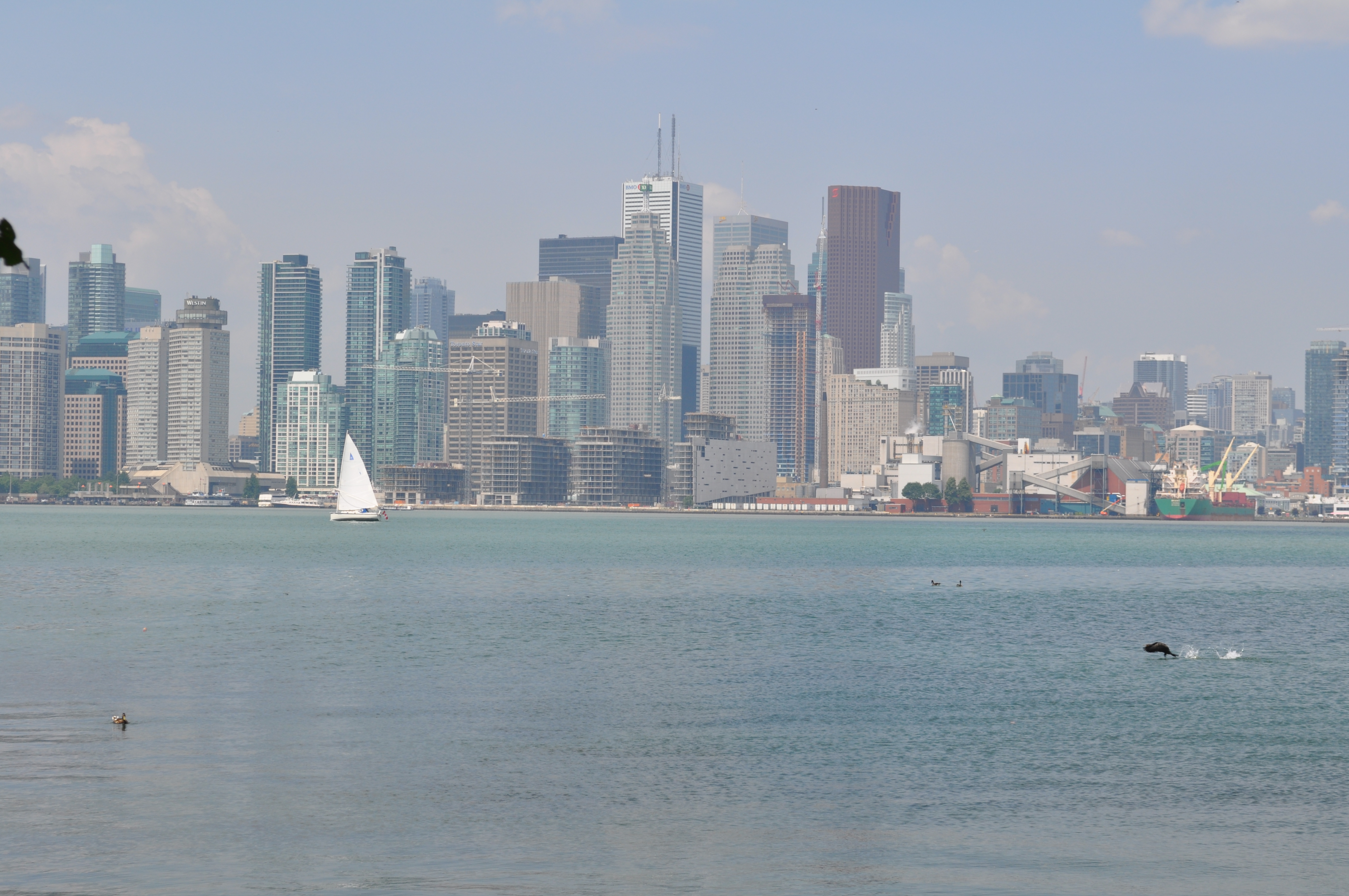
Toronto's mayor is as hazy as late afternoon look from Ward's Island

Toronto’s mayor is as hazy as late afternoon look from Ward’s Island

A mayor of a major metropolitan centre of Canada may skip a meeting of the Federation of Canadian Municipalities (FCM) for any number of reasons. He might, for example, be overwhelmed, juggling the urgent and competing demands of his office: negotiating with city workers, plotting the placement of new parks, fretting over the whereabouts of a certain video.

But Toronto honcho Rob Ford’s refusal to attend the FCM’s recent summit in Vancouver had more to do with principle than practicality. He just doesn’t like the cut of the organization’s jib, which, he thinks, luffs way too far to the left.

“Eighteen (Toronto) councillors flew out on Thursday,” he opined (according to the Globe and Mail) during this past Sunday’s edition of the radio show he co-hosts with his brother Doug, a Toronto councillor. “You know, the same councillors said ‘aw, you know, the city’s falling apart.’ Well where were they Thursday? Where were they Friday? You could shoot a cannon off at city hall.”

Mr. Ford’s implied contention that the FCM is a costly distraction from the real business of running a metropolis is oddly brave, given his own richly diverting circumstances these days. Beyond this, though, it misses the point. Canadian cities are, to varying degrees, facing serious challenges to their viability. And these challenges are, again to varying degrees, common right across the country.

The FCM is correct when it states in its 2013 Report on the State of Canada’s Cities and Communities that “The current division of powers encourages short term, informal and ad-hoc federal policies in the municipal sector, often designed without meaningful consultation with either municipal or provincial/territorial governments. The result is policies that respond to short-term political pressures and opportunities rather than address structural issues.”

The Federation wants Ottawa to “recognize the role of cities and communities in national prosperity, the challenges they face, and the national interest in vibrant, competitive and safe communities.” To do this, it demands a new deal with the feds that will “lead to the collaborative development of policies and programs that focus on those issues that remain unaddressed under outdated policies and jurisdictional obstacles.”

Those issues include: aging, even crumbling, transportation infrastructure; policing and public safety; affordable housing; and environmental protection.

The FCM’s 2012 report card notes that “a significant amount of municipal infrastructure rank between ‘fair’ and ‘very poor’—on average about 30%. The replacement cost of these assets alone totals $171.8 billion, nationally. . .More than half the roads surveyed fall below a rating of ‘good’: 32% are in ‘fair’ condition, and 20.6% are in ‘poor’ to ‘very poor’ condition, for a total of 52.6%”

Meanwhile, “A mixed picture emerges for wastewater infrastructure, with 40.3% of wastewater plants, pumping stations and storage tanks in ‘fair’ to ‘very poor’ condition, and 30.1% of pipes in ‘fair’ to ‘very poor’ condition. The replacement cost for the wastewater infrastructure in ‘fair’ to ‘very poor’ condition is $39 billion. . .With wastewater infrastructure now subject to new and more stringent federal regulations, even good or very good wastewater infrastructure may require upgrading or replacement.”

Those, like Mr. Ford, who insist that none of this should yield a closer and more  productive financial partnership with Ottawa fail to appreciate that, in the hierarchy of indisputable federal responsibilities (forget economic development or science and technology funding) to Canadians, apolitical support for infrastructure ranks near the top. There is nothing Liberal or Conservative about a bridge that’s about to collapse or, for that matter, a downtown events centre in Moncton that may never get built.

Of course, politicians of all stripes make partisan hay reminding people about their proud rural traditions. That’s because the message is clean and simple, unsullied and uncluttered by the diversity of opinions and opportunities that cities cradle.

Still, increasingly, Canadians are a decidedly urban folk. Citizens and resident immigrants, alike, are heading to the cities, not the countryside, to make lives for themselves. It stands to reason that relevant public investment should follow them there.

Tagged , ,

Rob Ford is ready for his close-up (again)

Trouble the water in Toronto

Trouble the water in Toronto

Now that Rob Ford is more popular than U.S. President Barack Obama and singing sensation Lady Gaga combined (at least according to Google searches), does Hollywood figure in the future of the world’s most famous mayor?

CTV reports, “In the wake of reported allegations he was seen on a drug video, Rob Ford searches on Google have surpassed some of the most popular figures in the world. In fact, on May 17, the day after Gawker and the Toronto Star reported on the alleged video featuring the mayor of Canada’s biggest city, Ford got more Google searches than (both Mr. Obama and Ms. Gaga) – that’s worldwide. Our Google Trends graph, which plots Google search terms based on search performance, shows the search term fluctuating in popularity from Jennifer Lawrence to Jay-Z levels ever since. Before the scandal, the mayor was about as popular on Google as Prime Minister Stephen Harper.”

And why not? The saga in Hog Town, where Mr. Ford reigns like King Lear – isolatedly and erratically – is made for the movies. Hell, this stuff even writes itself.

We may imagine the opening scene, in which the rotund, office-bound monarch ruminates on his life and the events that have brought him to this sorry state of affairs. He has just narrowly avoided a group of women who had arrived at City Hall with a birthday cake (he turned 44 on May 28), before entreating him to resign.

Then follows the flashbacks.

A happy and contented childhood attending Scarlett Heights Collegiate, playing football, horsing around with chums in the quasi-affluent Toronto borough of Etobicoke.

Vain attempts to keep up with his older brothers, Randy and Doug, whose extra-curricular activities may, or may not, have involved ritual dalliances with certain controlled substances late into the night and wee hours of the morning.

Ambitious dreams of becoming a professional football player; sitting out a season of university play on the bench; leaving Carleton after his freshman year; returning home to Toronto to join his Dad’s label- and tag-making business; hating it.

Then, in classic cinematic fashion, comes local politics to his rescue.

Three terms as a city councillor, during which he distinguished himself as an outspoken, if not always sensitive or even astute, observer of social values. And the gaffes. . .oh, the famous gaffes.

“If we wiped out the perks for council members, we’d save $100 million easy. . .all this office budget stuff is self-promotion to benefit yourself. Why should the taxpayers have to pay for it? It boggles my mind?”

His constituents loved him, the way Louisianians loved their populist firebrand Huey Long early in the last century. Mr. Ford’s big mouth could do no wrong, even when it uttered nonsense.

“We just need to get rid of these life-long politicians that just give out money to special interest groups and don’t serve the community. I’m really teed off. We need to get a new council or this city is going to go down the drain.”

And this: “If you are not doing needles and you are not gay, you wouldn’t get AIDS probably, that’s bottom line. Those are the facts.”

And this: “What I compare bike lanes to is swimming with the sharks. Roads are built for buses, cars, and trucks, not for people on bikes. My heart bleeds for them when I hear someone gets killed, but it’s their own fault at the end of the day.”

And, of course, this: “Those Oriental people work like dogs. They work their hearts out. They are workers non-stop. They sleep beside their machines. That’s why they’re successful in life.”

Then, in one dreadful moment, comes the Toronto Star and its allegations of a video that shows the mayor smoking what appears to be a crack pipe. And the great unravelling begins.

The accusations. The recriminations. The firings. The quittings. A city in turmoil. Reputations in tatters.

Still, at the end, there is that quieting denouement of all great, filmic melodramas – the silver lining, if you will.

We see a smile develop on Mr. Ford’s face. There is that birthday cake in the downstairs lobby, after all. It would be a shame to let it go to waste.

Fin. Fade to black.

Tagged , ,